

OR: Why I’m Giving Uncle Sam a Chapter Published in 1898 as an Award
by David E. McCarty, MD FAASM (…but you can call me Dave)
November 19, 2026
~ ~ ~ ~ ~
Whatever has been done before, may legally be done again.
— Jonathan Swift, Gulliver’s Travels, Part IV, Chapter V.
~ ~ ~ ~ ~

The American Medicine Time Travel Award 2026—AD STERQUILINIUM HISTORIAE REDIBIMUS, ALACRITER!!
Well, folks, the United States of ol’ A. has done it! We’ve perfected time travel! Good job, Uncle Sam!
And, as usual with time travel, this one comes with stories to tell!. LOL!
Get this! On November 17, the Pan American Health Organization announced that the United States had lost the measles elimination status it had held since 2000! That’s back a quarter century! WOOT! Turns out that one chain of measles transmission festered for more than a year, leading to outbreaks and everything! [1] SHEESH! That’s just like the ol’ days!!
I remember that I learnt about measles in medical school, but I never saw a case! This is just like Jurassic Park, and the dinosaurs! Measles again walks the Earth!!
What kinda ride are we about to experience? Turns out, that’s the reason for this awesome award…see, folks, another TIME MACHINE can take us there…
By happy coincidence, yesterday, one of my spouse’s patients bequeathed her with an original copy (whaaaaa???) of William Osler’s The Principles and Practice of Medicine, third edition, published in 1898 [2]. Feels like this book fell outta the sky into my hands, delivered by angels…

See, for today’s time-travel world, this can be considered an advance copy!
Anyway, enough jawin!!! Congratuations, America! Enjoy the read!
Kind mojo,
Dave
David E. McCarty MD FAASM
Boulder, Colorado
November 19, 2026 (?)
References:
[1][ Pan American Health Organization. Letter on U.S. measles elimination status. November 13, 2026. CDC. Joint statement on the loss of U.S. measles elimination status. November 17, 2026.
[2] Osler, W. The Principles and Practice of Medicine. 3rd ed. New York: D. Appleton and Company, 1898, pp. 85–89.

~ ~ ~ ~ ~
SECTION ONE: SPECIFIC INFECTIOUS DISEASES
CHAPTER VIII: MEASLES.
Editor’s note. Transcribed from the the public-domain document. Original wording, spellings, and period language are retained. Line wraps and running heads have been removed, and a re-created fever chart appears at the end of the paragraph it accompanies. The treatment section reflects nineteenth-century practice. For current clinical information, see the CDC’s measles clinical overview.
Definition.—An acute, highly infectious disorder, characterized by an initial coryza and a rapidly spreading eruption.
Etiology:—The infection of measles is very intense and immunity against attack not nearly so common as in scarlet fever. It is a disease of childhood, but unprotected adults are liable to the infection. Indeed, measles is more frequent in adults than is scarlet fever. Within the first six months of life the liability is not so marked, though infants of a month or three weeks may be attacked. The sexes are equally affected. The contagion is communicated by the breath and by the secretions, particularly those of the nose. It may be conveyed by a third person and by fomites.
The disease is practically endemic in large centres of population, and from time to time spreads and prevails epidemically. It occurs at all seasons, but prevails more extensively during the colder months. There is no infectious disease in which recurrence is more frequent. There may be a second, third, or even a fourth attack.
The contagium of the disease is unknown. No one of the various organisms which have been described meets the requirements of Koch’s law.
Morbid Anatomy.—Measles itself rarely kills, but the complications and sequelæ combine to make it a very fatal affection in children. There are no characteristic post-mortem appearances. The skin changes are those associated with an intense hyperæmia.
There is a catarrhal condition of the mucous membranes, particularly of the bronchi. The fatal cases show almost invariably either broncho-pneumonia, capillary bronchitis with patches of collapse, or less frequently lobar pneumonia. The bronchial glands are invariably swollen. Pleurisy is less common. During convalescence from measles there is a special liability to tuberculous invasion, and tuberculous broncho-pneumonia claims a large number of victims. The bronchial glands may also be affected.
The gastro-intestinal mucosa may be hyperæmic. Swelling of Peyer’s glands is not at all uncommon and may reach a very intense grade in the patches.
Symptoms.—Incubation.—“From seven to eighteen days; oftenest fourteen.” The disease has been frequently inoculated. In such cases the incubation period is less than ten days.
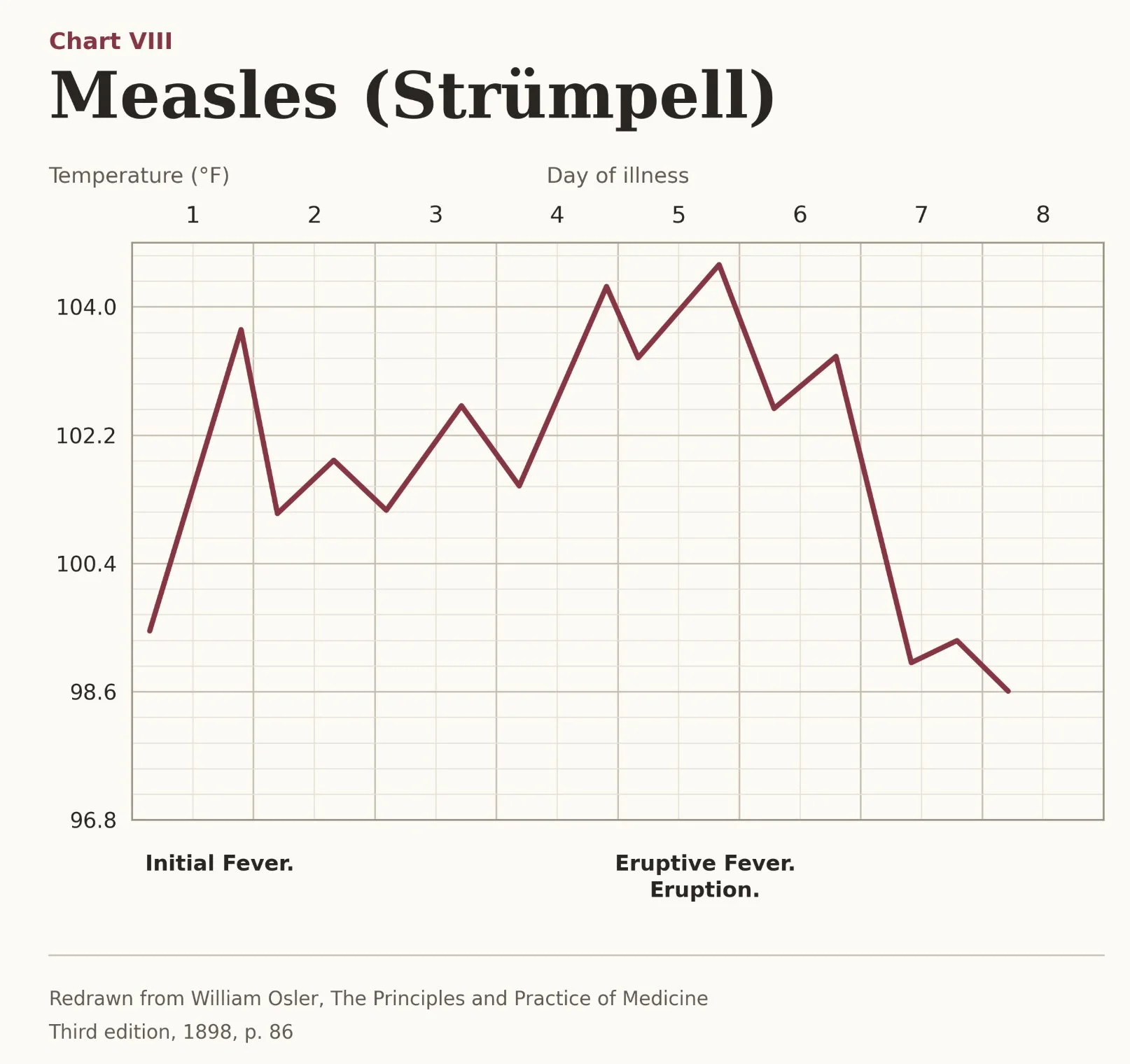
Invasion.—The disease usually begins with symptoms of a feverish cold. There are shiverings (not often a definite chill), marked coryza, sneezing, running at the nose, redness of the eyes and lids, with photophobia, and within twenty-four hours cough. These early catarrhal symptoms are more marked in measles than in any other infectious disease of children. There may be the symptoms so commonly associated with an on-coming fever—nausea, vomiting, and headache. The tongue is furred. Examination of the throat may show a reddish hyperæmia or in some instances a distinct punctiform rash. Occasionally this spreads over the whole mucous membrane of the mouth with the exception of the tongue. The temperature at this stage is usually high, reaching from 103° to 104°, ascending gradually through the second and third days.
Eruption.—Usually on the fourth day, when the fever and general symptoms have reached their height, the rash appears upon the cheeks or forehead in the form of small red papules, which increase in size and spread over the neck and thorax. When the eruption becomes well developed the face is swollen and covered with reddish blotches, which often have rounded or crescentic outlines. Here and there is an intervening portion of unaffected skin. At this stage the cervical lymph-glands may be slightly swollen and sore; sometimes also the glands in the groins, axillæ, and at the elbows. The papules can now be felt with the finger. Sometimes they are quite shotty, but do not extend deep into the skin. On the trunk and extremities the swelling of the skin is not so noticeable, the color of the rash not so intense and often less uniform. The mottled, blotchy character of the rash appears most clearly on the chest or the abdomen. The rash is hyperæmic and disappears on pressure, but in the more malignant cases it may become hæmorrhagic. The general symptoms do not abate with the occurrence of the eruption. They persist until the end of the fifth or the sixth day, when in the majority of the cases all the symptoms become mitigated. Among the peculiarities of the rash may be mentioned the development of numerous miliary vesicles and the occurrence of petechiæ, which are seen occasionally even in cases of moderate severity.
Chart VIII.—Measles (Strümpell).
Desquamation.—After persisting for two or three days the rash gradually fades and desquamation occurs in the form of very fine branny scales, which may be difficult to see and are wholly unlike the coarse exfoliation in scarlet fever.
The catarrhal symptoms gradually disappear and convalescence is rapidly established.
In epidemics of measles atypical cases are common. The rash may appear early, within thirty-six hours of the onset of the symptoms; or, on the other hand, it may be delayed until the sixth day. As in other exanthems, when many cases occur in a household, one of the children may have all the initial symptoms and “sicken for the disease,” as it is said, but no eruption appears.
The most serious variety of measles is that in which hæmorrhages occur—the morbilli hæmorrhagici. In general practice these cases are very uncommon. Occasionally in institutions, particularly when the hygienic surroundings are bad, one or two cases develop during an epidemic. It has been frequently seen in camps and when the disease is freshly imported into a native population, as in the Fiji Islands. During the civil war, as shown by Smart’s statistics, some cases occurred.
In this form the disease sets in with much greater intensity, the rash becomes petechial, hæmorrhages occur from the mucous membranes, the constitutional depression is very great, and death occurs early from toxæmia.
Complications and Sequelæ.—The existing bronchitis is apt to extend into the smaller tubes and lead to collapse and broncho-pneumonia. When limited in extent, this causes only aggravation of the cough and persistence of the fever (symptoms which gradually abate), and convalescence is rapid; but in debilitated children, more particularly in institutions and among the lower classes, this complication is extremely grave and is responsible for the high death-rate from measles in the community. In some instances the clinical picture is that of a suffocative catarrh, the result of a widespread involvement of the smaller tubes. The description of the condition will be found under Broncho-pneumonia. Lobar pneumonia is less common and perhaps less dangerous.
Laryngitis is not uncommon: the voice becomes husky and the cough croupy in character. Œdema of the glottis is very rare. Pseudo-membranous inflammation of the pharynx and larynx may occur and prove fatal. In debilitated infants severe stomatitis, cancrum oris, or ulcerative vulvitis may develop.
Catarrhal inflammation of the middle ear is not very uncommon, and may proceed to suppuration and to perforation of the drum. The conjunctival catarrh rarely leads to further trouble, though occasionally the inflammation becomes purulent.
Intestinal catarrh is common in some epidemics, and there may be the symptoms of acute colitis.
Nephritis is an exceedingly rare complication.
Of the sequelæ of measles, tuberculosis is the most important—either an involvement of the bronchial glands, a miliary tuberculosis, or a tuberculous broncho-pneumonia. Arthritis is rare. I have known anchylosis of the jaw to follow measles in a child of four years.
Among the rarer sequelæ are paralyses. Hemiplegia is very rare, but cases of paraplegia have been described. Thomas Barlow reports a fatal case in which the symptoms occurred early, the paralysis extended rapidly and involved the upper limbs, and death took place on the eleventh day. Marked vascular changes were found in the gray matter of the spinal cord, and were believed to depend on an early disseminated myelitis. Examination of the peripheral nerves was not made. While some of these cases are due to an ascending myelitis, others are probably the result of a post-febrile polyneuritis.
Diagnosis.—From scarlet fever, with which it is most likely to be confounded, measles is distinguished by the longer initial stage with characteristic symptoms, and the blotchy irregular character of the rash, which is so unlike the diffuse uniform erythema of scarlet fever. Occasionally in measles, when the throat is very sore and the eruption pretty diffuse, there may at first be difficulty in determining which disease is present, but a few days should suffice to make the diagnosis clear. As a rule there is no leucocytosis. It may be extremely difficult to distinguish from rötheln. I have more than once known practitioners of large experience unable to agree upon a diagnosis. The shorter prodromal stage, the slighter fever in many cases, are perhaps the most important features. It is difficult to speak definitely about the distinctions in the rash, though perhaps the more uniform distribution and the absence of the crescentic arrangement are more constant in rötheln. In Africans the disease is easily recognized, even in the black; the papules stand out with great plainness, often in groups; the hyperæmia is to be seen on all but the very black skins. The distribution of the rash, the coryza, and the rash in the mouth are important points.
The conditions under which measles may be mistaken for small-pox have already been described. Of drug eruptions, that induced by copaiba is very like measles, but is readily distinguished by the absence of fever and catarrh.
Prognosis.—The mortality bills of large cities show what a serious disease measles is in a community. Among the eruptive fevers it ranks third in the death-rate. The mortality from the disease itself is not high, but the pulmonary complications render it one of the most serious of the diseases of children.
In some epidemics the disease is of great severity. In institutions and in armies the death-rate is often high. The fever itself is rarely a source of danger. The extension of the catarrhal symptoms to the finer bronchial tubes is the most serious indication.
Treatment.—Confinement to bed in a well-ventilated room and a light diet are the only measures necessary in cases of uncomplicated measles. The fever rarely reaches a dangerous height. If it does it may be lowered by sponging or by the tepid bath gradually reduced. If the rash does not come out well, warm drinks and a hot bath will hasten its maturation. The bowels should be freely opened. If the cough is distressing, paregoric and a mixture of ipecacuanha wine and squills should be given. The patient should be kept in bed for a few days after the fever subsides. During desquamation the skin should be oiled daily, and warm baths given to facilitate the process. The convalescence from measles is the most important stage of the disease. Watchfulness and care may prevent serious pulmonary complications. The frequency with which the mothers of children with simple or tuberculous broncho-pneumonia tell us that “the child caught cold after measles,” and the contemplation of the mortality bills should make us extremely careful in our management of this affection.