
Yesterday Was World Narcolepsy Day (Don’t Forget!)
By David E. McCarty MD FAASM (…but you can call me Dave)
23 September 2026
~ ~ ~ ~ ~
The word “remember” slipped my mind a thousand times.
—Rob Shaia
“Mrs. Control,” Fred Got Beaten By The Ugly Stick; from the album DUCKY (1993)
~ ~ ~ ~ ~
World Narcolepsy Day…DON’T FORGET!!
The Remembering
Yesterday was World Narcolepsy Day.
I meant to post something. I intended to post something. I got involved in clinic, which ran over. Then there was my friend Jerry Simmons’ IRB meeting. Then there was dinner. Then…what time is it?
Let’s face it, Life Fans! Life got in the way!
I forgot.
There is something wonderfully ironic about that, and perhaps even something useful.
Every September 22, people around the world come together for World Narcolepsy Day, an international effort to increase public knowledge, reduce stigma, elevate the voices of people living with narcolepsy, and—perhaps most importantly—shorten the astonishingly long road to diagnosis.[1] Project Sleep reports that people with narcolepsy commonly travel 8 to 15 years between symptom onset and proper diagnosis.[1]
Awareness matters.
Recognition matters.
Remembering matters.
But awareness can only get us so far.
Because there is another way that people with narcolepsy get lost.
Sometimes we find something else first.
~ ~ ~ ~ ~
The Trouble With Finding Something
Diagnostic medicine has a fascinating cognitive vulnerability called search satisficing.
The idea is almost embarrassingly simple:
Once we find something, we tend to stop looking.
Search satisficing belongs to a family of cognitive errors that includes anchoring and premature closure. The phenomenon is well recognized in the diagnostic-error literature: a search gets called off because something has been found that appears to explain the problem.[2,3]
Sometimes, of course, what we found really IS the answer. The old saying in Internal Medicine sounds a bit like an aphorism from Mark Twain:
You can have FLEAS and TICKS TOO.
The point is: human beings are allowed to have more than one thing wrong with them.
This inconvenient truth presents a particular problem in sleep medicine.
Imagine a person who comes to us because they are profoundly sleepy during the day. We perform a sleep study and discover that it fits the diagnostic criteria for obstructive sleep apnea.
Aha!
We found it!
SLEEP APNEA!
We prescribe treatment. The numbers improve. The airway looks better. Everyone congratulates themselves on a job well done.
There’s just one small detail worth mentioning:
The patient is still sleepy!
This is precisely where medicine must resist the seductive little voice that says:
But we already found the answer.
No.
We found AN answer.
For the patient traversing our medical system in real time, those are VERY different things.
Life-Fans, this isn't merely a theoretical concern. In one series of 133 patients with narcolepsy, nearly one-quarter also had obstructive sleep apnea. Ten had initially been diagnosed only with OSA, delaying recognition of their narcolepsy by an average of more than six years.[4]
They had something real. They had “Sleep Apnea”…
It just wasn't the whole answer.
~ ~ ~ ~ ~
Remember the Five Fingers
This is a major reason I have spent so many years teaching what I call the Five Finger Approach (FFA).[3]
Avid fans of this column will recall that it was the above-mentioned search-satisficing cognitive trap that ensnared a team of SLEEP SPECIALISTS—arguably, a team of doctors who don’t need to be “made aware” of narcolepsy!—and baffled the diagnosis of narcolepsy for nearly half a decade, prompting the creation of this tool.
(See: “The Story About When D’Aria Embarrassed Her Doctors and Helped Invent the Five Finger Approach,” at EmpoweredSleepApnea.com.)
The FFA is a transdiagnostic way of thinking about sleep complaints. Instead of allowing a diagnostic label to terminate the investigation, it forces us to keep five broad domains of sleep-wake health simultaneously available to consciousness.[3]
The Thumb reminds us to think about circadian biology.
The Index Finger reminds us to examine pharmacology and chemistry—the medications, substances, stimulants, sedatives, caffeine, alcohol, and other chemical influences that alter sleep and wakefulness.
The Middle Finger reminds us to look for medical causes.
The Ring Finger reminds us about psychological and behavioral contributors.
And the Pinky reminds us about the primary sleep disorders themselves—including sleep apnea, restless legs syndrome, insomnia, parasomnias, central disorders of hypersomnolence, and, yes, narcolepsy.
The point is not that every sleepy person has five things wrong with them.
The point is that we should remember to look.
The Five Finger Approach gives us a cognitive forcing strategy against premature closure. Before declaring the mystery solved, we can look at our own hand and ask:
What else could this be?
~ ~ ~ ~ ~
…and Then There Are The Five Reasons…
There is another safeguard that belongs beside the Five Finger Approach.
The Five Reasons to Treat (FReTT) asks a different question.[5]
Once we have identified something like sleep apnea, why are we treating it in the first place?
At the ISLE OF SLEEP APNEA—and, practically, in the ecosystem I oversee at Rebis Health—the five domains are:
RISK. SNORING. SLEEP. WAKE. COMORBIDITIES.[5]
That distinction matters enormously.
Suppose someone comes to us because they cannot stay awake. Their sleep study demonstrates obstructive sleep apnea. We treat the sleep apnea.
Excellent.
But WAKE was one of our reasons for treating them.
So what happens if their apnea improves and their wake experience doesn't?
We don't get to move the goalposts.
We don't get to say that treatment was successful simply because a machine-generated number became prettier.
We return to the question that brought the human being into the room:
Are you less sleepy?
Likewise, perhaps their complaint was terrible, fragmented, unrefreshing sleep.
SLEEP was the reason for treatment.
If the airway is better but the sleep isn't, something remains unexplained.
The Five Reasons to Treat therefore creates something like a clinical return address.
It reminds us where the journey began.
And when SLEEP or WAKE fails to improve despite adequate treatment of the thing we found, there is a very simple instruction:
Go back to the hand!
Circadian.
Chemistry.
Medical.
Psychological.
Primary sleep disorders.
Start looking again.
This isn't merely philosophical. Persistent excessive daytime sleepiness despite optimized treatment of obstructive sleep apnea is well recognized, and its evaluation requires reconsideration of other potential contributors—including insufficient sleep, medications, psychiatric and medical disorders, circadian factors, and central disorders of hypersomnolence.[6]
Because the diagnosis of sleep apnea does not confer immunity from narcolepsy.
~ ~ ~ ~ ~
This is Why Ellen and I Were Holding Those Signs!
This brings me back to World Narcolepsy Day.
My friend and collaborator Ellen Stothard, PhD, and I recently appeared in a video produced by PWN4PWN—you know?…People With Narcolepsy for People With Narcolepsy—that really RAD organization devoted to education and support for people living with narcolepsy and idiopathic hypersomnia.[7]
In the video, if you don’t blink, you’ll notice that Ellen and I are holding little pieces of paper, reminding folks not to forget the Five Finger Approach and the Five Reasons to Treat.
Now you know why.
They are reminders to keep thinking.
Reminders to WAKE UP!
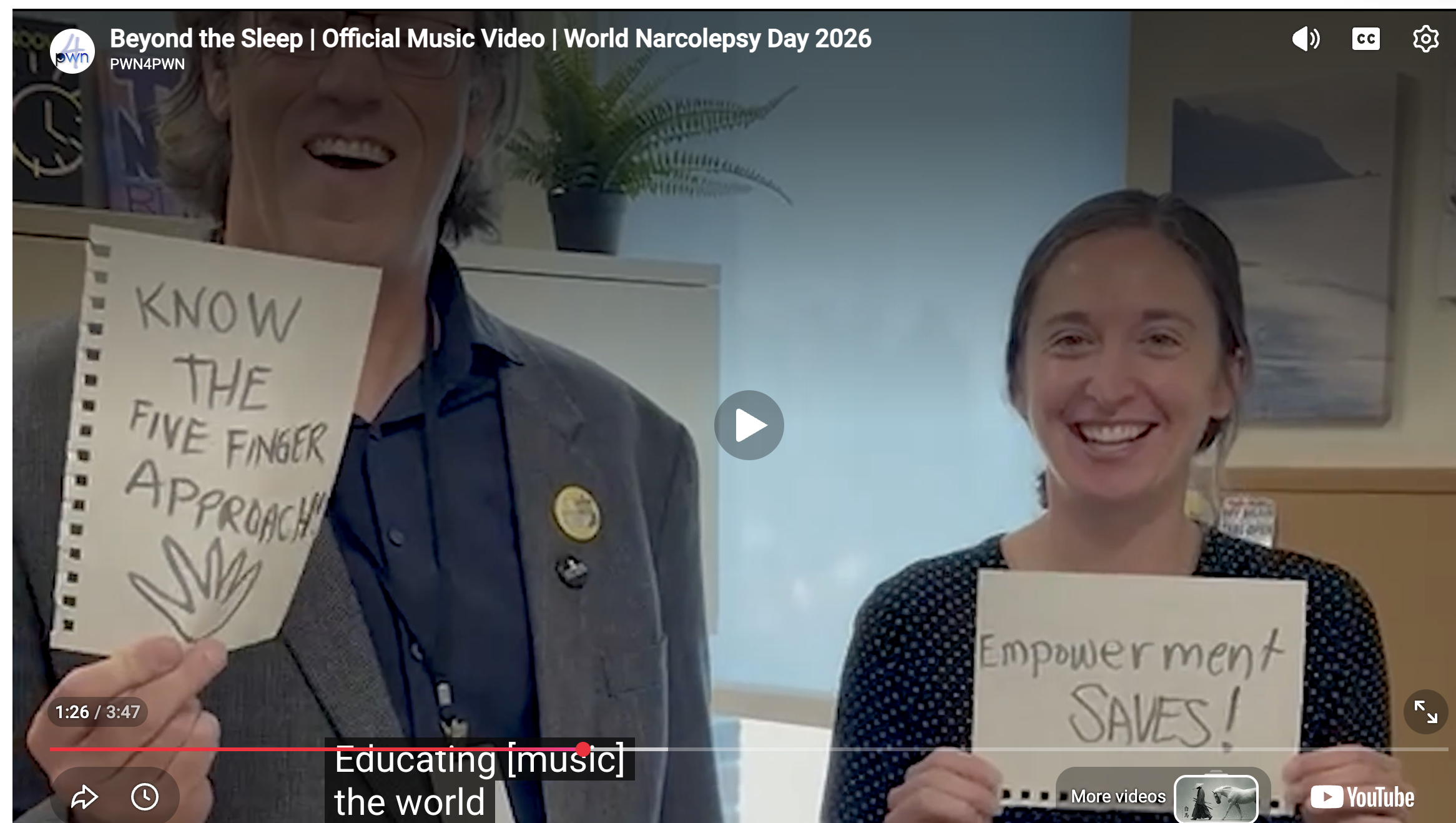
…check us out about a minute and a half in…
Narcolepsy awareness means teaching people what narcolepsy looks like. It means teaching about excessive daytime sleepiness, cataplexy, disrupted nighttime sleep, sleep paralysis, hallucinations, REM physiology, orexin biology, and the testing we use to identify central disorders of hypersomnolence.[8]
That work is essential.
But perhaps awareness must also mean something larger.
We need to teach patients and clinicians how to recognize when the explanation they already possess has stopped explaining the person sitting in front of them.
A patient can have sleep apnea and narcolepsy. A patient can have sleep apnea and circadian misalignment. A patient can have sleep apnea and medication effects. A patient can have sleep apnea and insomnia.
Finding one true thing does not make every other possibility false.
That may be one of the most dangerous peculiarities of diagnostic labels:
The label can be correct and still leave the patient behind.
~ ~ ~ ~ ~
Denoument (DON’T FORGET!!)
Yesterday was World Narcolepsy Day. Let’s face it: life got in the way.
I forgot!
Today I remembered what I wanted to NOT FORGET.
Folks, maybe that’s as good a metaphor as any for the work still ahead of us.
Awareness asks us to remember that narcolepsy exists.
Good clinical reasoning asks something harder:
Don't forget to keep looking.
STAY AWAKE!
Kind mojo,
DAVE
David E. McCarty MD FAASM
Chief Medical Officer, Rebis Health
Co-creator (with Ellen Stothard, PhD), Empowered Sleep Apnea project
~ ~ ~ ~ ~
References
1. Project Sleep. World Narcolepsy Day. Accessed September 23, 2026. https://project-sleep.com/world-narcolepsy-day/
2. Gupta A, Graber ML. From possible to probable to sure to wrong — premature closure and anchoring in a complicated case. AHRQ Patient Safety Network. September 1, 2012. Accessed September 23, 2026. https://psnet.ahrq.gov/web-mm/possible-probable-sure-wrong-premature-closure-and-anchoring-complicated-case
3. McCarty DE. Beyond Ockham’s razor: redefining problem-solving in clinical sleep medicine using a “five-finger” approach. J Clin Sleep Med. 2010;6:292-296.
4. Sansa G, Iranzo A, Santamaria J. Obstructive sleep apnea in narcolepsy. Sleep Med. 2010;11:93-95.
5. McCarty DE, Stothard E. Empowered Sleep Apnea: A Handbook for Patients and the People Who Care About Them. Pennsauken, NJ: BookBaby; 2022. ISBN 978-1-66785-800-5.
6. Lal C, Weaver TE, Bae CJ, Strohl KP. Excessive daytime sleepiness in obstructive sleep apnea: mechanisms and clinical management. Ann Am Thorac Soc. 2021;18:757-768.
7. People With Narcolepsy for People With Narcolepsy. About PWN4PWN. Accessed September 23, 2026. https://www.pwn4pwn.org/about-us/
8. Bassetti CLA, Adamantidis A, Burdakov D, et al. Narcolepsy — clinical spectrum, aetiopathophysiology, diagnosis and treatment. Nat Rev Neurol. 2019;15:519-539.
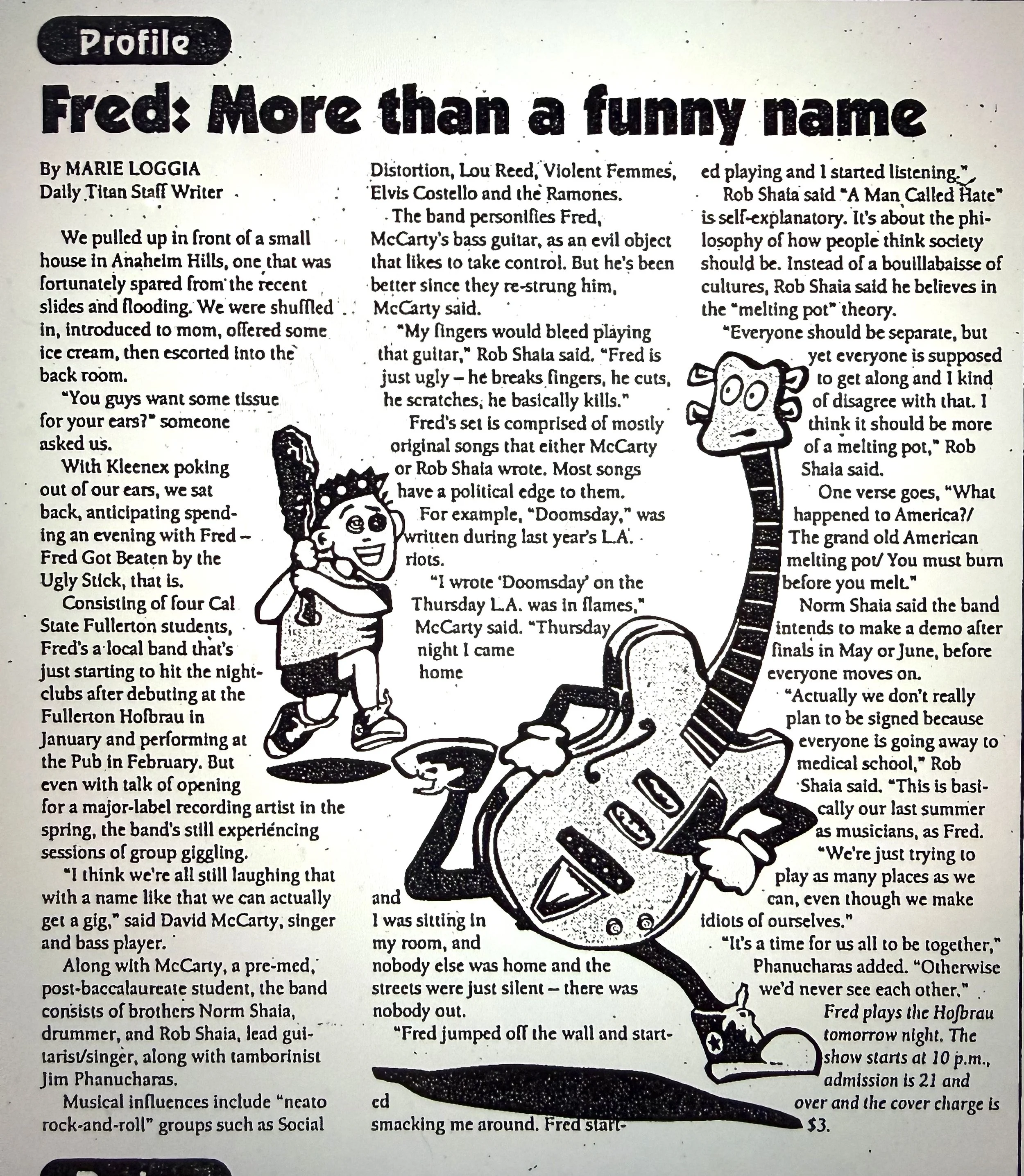
From: Cal State Fullerton’s Daily Titan, March 25, 1993