
RESISTANCE IS FUTILE (and Counterproductive!)
OR: How The Buddha might think about The Five-Finger Approach—and how that helps us hunt for the forces that stand between a patient and sleep!
By David E McCarty MD FAASM (…but you can call me Dave)
2 September 2026
~ ~ ~ ~ ~
“Letting go gives us freedom, and freedom is the only condition for happiness.”
—Thích Nhất Hạnh, The Heart of the Buddha’s Teaching
~ ~ ~ ~ ~
WWTBD? (What Would The Buddha Do?)
Clinical sleep medicine is, at heart, the work of identifying and removing obstacles to restorative sleep and optimized wakefulness.
The recurring adversary across its many diagnoses may be understood as RESISTANCE: the friction, opposition, and counter-effort that stand between a patient and sleep.
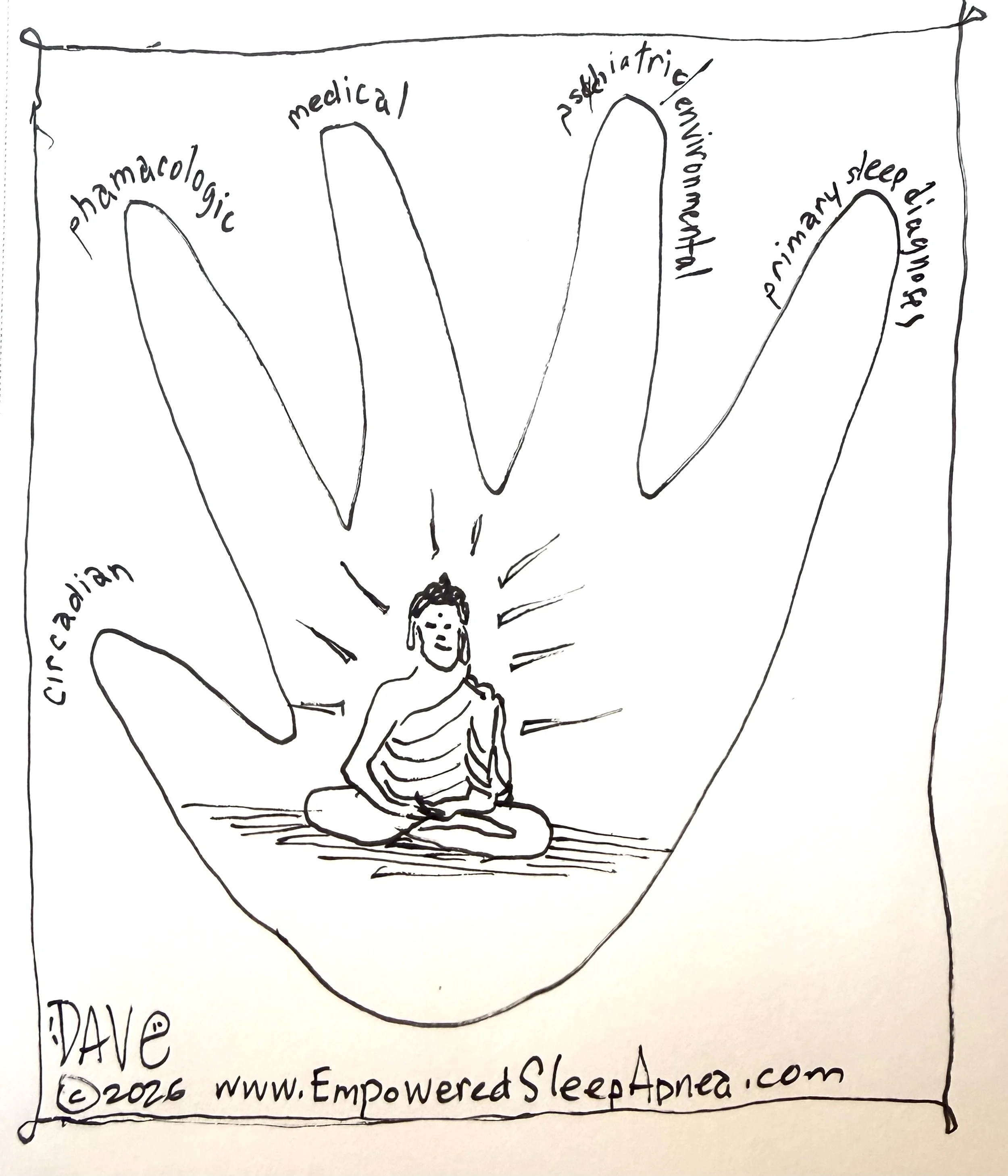
Buddhist contemplative traditions teach that suffering is amplified by resistance to present reality and eased by acceptance. Read through that lens, the transdiagnostic Five-Finger Approach [1] becomes a systematic hunt for sources of resistance across five functional domains: circadian, pharmacologic, medical, psychiatric or psychosocial, and primary sleep diagnoses. The metaphor is deliberate, including its most provocative literal instance—upper airway *resistance*—where relief requires external mechanical help rather than equanimity.
I’m not replacing mechanistic sleep medicine with philosophy…think of this more like an effort to give clinicians and trainees a memorable, transdiagnostic heuristic. If The Buddha were here, he might extol us to:
“look broadly for the forces opposing sleep,
determine what kind of resistance each one represents,
and respond in a way that is both clinically sound and humane…”
The Ubiquitous “R” Word
Ockham’s razor teaches the student of medicine to seek a single unifying diagnosis.
In clinical sleep medicine, this instinct tends to fail more often than it serves.
The cardinal complaints we field in this discipline—daytime impairment and disturbed nocturnal sleep—are final common pathways with a broad differential, and multiple contributors commonly coexist in the same patient.[1] The Five-Finger Approach was devised precisely to counter diagnostic parsimony. It offers five functional domains as candidate sources of sleep-wake disruption: circadian misalignment, pharmacologic factors, medical factors, psychiatric or psychosocial factors, and primary sleep medicine diagnoses.[1]
My interest in resistance began with a reflection on Buddhist principles. Let’s face it: a great deal of human suffering arises not from what happens to us, but from how we respond to it! To hear The Buddha tell it, the path through that suffering begins with acceptance and the release of counterproductive striving.
Applied to sleep, the parallel is uncanny. The person with insomnia who lies awake straining to sleep is engaged in the kind of effortful resistance that Buddhist teaching identifies as self-defeating.
However, as I pondered it, the “R” word refused to remain in the psychological lane. It reappeared in the circadian domain, where a patient may be fighting an endogenous rhythm; in pharmacology, where substances may oppose normal sleep architecture; and, most literally, in the upper airway, where resistance is a measurable mechanical and fluid-dynamic quantity. Could resistance serve as a transdiagnostic organizing principle for the Five-Finger Approach?
Word nerds: I’m using the term here as a deliberate double entendre. In some domains, it describes psychological or behavioral opposition. In others, it describes physiology that interferes with sleep. In the upper airway, it is literal—and the therapeutic implication is reversed.*
*N.B.: The inversion is not a flaw to conceal..it’s what keeps our metaphor honest!
What Would Buddha Do?
Here’s some food-for-thought for us to chew on:
…distressing internal experiences
tend to be compounded
by our efforts to suppress, control, or escape them…
And the point of this pontification: a Buddhist stance of nonjudgmental acceptance (i.e.: “release of resistance”) may reduce that secondary layer of suffering.
In modern clinical psychology, this maps onto the concepts of *experiential avoidance* and *psychological flexibility* that are foundational to so-called Acceptance and Commitment Therapy (ACT). ACT encourages patients to respond to internal experiences “in an accepting rather than controlling manner” while acting in accordance with their values.[2] What about meditation? Mindfulness practice is similarly characterized as a nonreactive awareness that “promotes psychological distancing through acceptance . . . and thus enhances resilience rather than resistance.”[3] The vocabulary of the field has already framed the choice as one between acceptance and resistance.
Ong and colleagues formalized this distinction for insomnia in their metacognitive model, separating primary arousal—the cognitive and somatic activation that directly interferes with sleep—from secondary arousal: the appraisals, worry, and effortful striving about the experience of NOT SLEEPING itself.[4] In this model, mindfulness and acceptance do not force sleep, but instead cultivate balanced appraisal, cognitive flexibility, equanimity, and commitment to values, thereby reducing sleep-related arousal and permitting remission.[4]
This is the Buddhist premise in clinical dress: the patient stops fighting, and the fight itself was part of the problem.
The Buddha might say that when we reach for the butterfly and grab for it, it flies away. We must allow the butterfly to land.
Resistance as effort: the psychiatric and psychosocial domain
The metaphor applies most cleanly to the psychiatric and psychosocial finger where insomnia may be perpetuated by hyperarousal and by the maladaptive self-talk of a person who has come to experience the bed as an arena of failure.
In the Five Finger Approach, this domain is our fourth stop…the RING finger…our reminder to check in with the patient regarding their environment, the mental health, their sense of psychological safety. I’m talking about it first, because I think that’s where our journey of this idea should start.
Turns out, when we get to the RING finger, a review of a patient’s self-talk about sleep is in order!
Here, resistance is the patient’s own counter-effort: the performance anxiety of trying to fall asleep, the catastrophic prediction of tomorrow’s ruin, and the rigid rules and constant monitoring that transform sleep from an autonomic release into a graded task.
Cognitive therapy within CBT-I addresses this problem directly. It uses Socratic questioning to revise unhelpful beliefs and reduce excessive worry about sleep and its daytime consequences.[5] Its most vivid technique is *paradoxical intention*: asking the patient to try to remain awake in order to relieve the performance anxiety produced by trying to force sleep.[5]
A systematic review and meta-analysis found that paradoxical intention produced large improvements in insomnia symptoms relative to passive comparators and moderate improvements relative to active comparators, with marked reductions in sleep-related performance anxiety, its proposed mechanism.[6] You can think of “Paradoxical intention” as being “RESISTANCE IS FUTILE” mapped onto clinical practice. The patient lays down the struggle to sleep, allowing sleep to arrive.
Striking empirical support comes from a component network meta-analysis of 241 trials involving more than 31,000 participants. Cognitive restructuring (incremental odds ratio [iOR], 1.68; 95% CI, 1.28–2.20) and third-wave or acceptance components (iOR, 1.49; 95% CI, 1.10–2.03) were among the beneficial elements of CBT-I, whereas relaxation procedures were potentially counterproductive (iOR, 0.81; 95% CI, 0.64–1.02).[7] The contrast is arresting: an effortful attempt to relax may backfire, while a stance of nonstriving acceptance may help.
Seems that relaxation pursued as “one more task to perform” can easily morph into RESISTANCE, just in a softer costume.
Acceptance-based treatments carry this logic further. In a randomized comparative-effectiveness trial involving women veterans, an ACT-based treatment for insomnia was noninferior to CBT-I on key sleep outcomes at three-month follow-up and improved adherence on some measures.[8] That’s worth noting, for a therapy that’s not specific to sleep complaints!
An updated meta-analysis found that ACT produced moderate-to-large improvement in insomnia severity compared with waitlist or standard control (standardized mean difference [SMD], −0.67; 95% CI, −1.08 to −0.25), with no significant difference from CBT-I immediately after treatment or at six-month follow-up. CBT-I, however, remained superior for remission immediately after treatment.[9] Internet-delivered ACT also improved sleep quality and insomnia symptoms compared with passive controls, although the certainty of evidence was low.[10]
Two caveats matter, here. First, CBT-I remains the gold standard for insomnia treatment because its evidence base is larger and more consistent. Acceptance-based approaches like ACT generally take longer to produce benefit and are supported by fewer data.[5],[9] Second, the incremental value of adding mindfulness to CBT-I has been inconsistent across trials.[3],[11] Acceptance is a useful lens, not a panacea.
That said: nothing in this argument requires it to be one.
Circadian resistance
The usual starting point for the journey of discovery within the Five Finger Approach is the THUMB, a consideration of the patient’s circadian sleep phase and the amplitude of signaling of that phase, relevant to their complaints.
In the circadian domain, resistance is the friction between behavior and the endogenous clock. The shift worker, the delayed adolescent, and the jet-lagged traveler may all attempt to sleep or wake in defiance of internal timing. The cubicle-bound patient who never goes outside may have blurry day-night circadian signaling contrast, or poor circadian amplitude signaling.[14]
See: slushy or inconsistent day-night signaling can generats the same kind of effortful, unsuccessful striving for sleep that’s seen in the psychological domain.
Here, the Buddhist frame suggests a specific kind of acceptance. Rather than continuing to fight the clock’s phase or the light-dark cycles of our planet, the clinician helps the patient recognize it and realign with it through appropriately timed light (hello, sunlight during the day! Hello, darkness during the night!), and, when indicated, chronobiotics.
This is not passive resignation. It is the abandonment of a losing fight against physiology in favor of working with it. Circadian misalignment is one of the five explicit domains of the original framework, and its inclusion guards against the common error of treating a phase disorder as though it were primary insomnia.[1]
Chemical & Pharmacologic Resistance
The index finger (pharmacologic factors) contains substances that oppose sleep: stimulants, activating antidepressants, beta blockers, decongestants, corticosteroids, alcohol, caffeine, nicotine…and substances that interfere with clarity of wakefulness: sedatives, anticholinergics, beta blockers, neuroleptics, anti-convulsants…the lists for both could go on and on.
Here, our metaphor for “find and eliminate resistance” bends but does not break. These agents can become exogenous sources of resistance to normal sleep architecture and/or the normal experience of wakefulness, and the clinical task is subtractive: identify the offending chemistry and, where possible, remove it or change its timing.[1]
In this domain, acceptance may belong as much to the clinician as to the patient. We must remain willing to recognize that an iatrogenic or self-administered substance, rather than an occult primary disorder, may be the culprit.
Medical Resistance
The medical finger includes pain, nocturia, dyspnea, reflux, pruritus, and the medications used to treat them.[12],[13] These conditions strain the metaphor in its psychological sense because they are sources of arousal to be *treated*, not accepted. Acceptance is the wrong prescription for treatable nocturnal pain.
The unifying idea therefore belongs at a higher level of abstraction. The constant across the five fingers is not that acceptance cures everything. It is that the clinician must conduct a hunt for modifiable sources of resistance to sleep.
Acceptance is one therapeutic response among several, chiefly relevant to effort-driven psychological contributors. Other forms of resistance demand pharmacologic, mechanical, or disease-specific solutions.
Primary Sleep Diagnoses and the Literal Pun--UPPER AIRWAY RESISTANCE
The pinky finger is a survey of all the diagnoses populating the International Classification of Sleep Disorders, which at the time of this writing, is in its 3rd edition. This domain includes includes familiar diagnostic entities like obstructive sleep apnea, upper airway resistance syndrome, restless legs syndrome, narcolepsy, and the parasomnias.[15]
Here, our metaphor has a happy cocreative accident with its physical twin: upper airway resistance is not a state of mind, but can be conceived of as a mechanical, involuntary, anatomically determined obstruction to airflow. Clearly: it would be both foolish and dangerous to suggest that equanimity can treat it. No amount of acceptance opens a collapsing pharynx or allows effortless nasal breathing when that organ is anatomically blocked.
So, it’s here I want to identify the crucial inversion of our metaphor. With effort-driven insomnia, the therapeutic direction may be to relinquish effort—to stop resisting wakefulness and trying to force sleep. With physical airway resistance, the obstruction is real and independent of the patient’s will. Its relief requires help from outside: positive airway pressure to pneumatically splint the airway, an oral appliance to forward position the jaw, expansive dentofacial orthopaedic options (including tongue mobilization and myofunctional therapy) to allow easier effortless nasal breathing, positional therapy, implantable nerve stimulators, or various targeted surgeries. The point: there are choices, and a lot of them. In this setting, to overcome resistance, active intervention is exactly right. A patient who “accepts” untreated severe sleep apnea is not enlightened but endangered.
The point here is that the resistance must first be recognized, and the moving parts contributing to it (ideally) should be identified and named.
For me, the contrast at this stop in our journey sharpens rather than weakens the argument. The Buddhist frame does not counsel indiscriminate acceptance of every circumstance. Mature contemplative traditions distinguish between what can be changed and what must be accepted. The clinical analogue is the discipline of diagnosis: deciding, resistance by resistance, whether the correct response is to release effort or apply it.
The upper airway keeps the metaphor honest. It reminds us that resistance is sometimes a mechanical fact requiring mechanical relief, and that mislabeling such a patient’s struggle as psychological is itself a diagnostic failure. The pun becomes a teaching device because it forces us to ask, at every finger:
What kind of resistance is this, and does it call for letting go or lending help?
Resistance as a Transdiagnostic Organizing Principle
The practical value of our Buddhist frame is heuristic.
The Five-Finger Approach was designed as a real-time completeness check for the sleep encounter and a scaffold for teaching comprehensive problem-solving.[1] Reframing each finger as a possible source of resistance gives the mnemonic an active verb: the clinician-patient team is supposed to hunt.
Of course, our FFA mnemonic also carries a built-in reminder that multiple sources commonly coexist. The result is a shared therapeutic vocabulary spanning the behavioral and the mechanical. In every domain, the questions are the same: Where does the resistance live? What kind of resistance is it? Should it be met with acceptance, removal, realignment, treatment, or external support?
Two axes must remain separate. The first is diagnostic: resistance is what the clinician searches for across all five fingers. The second is therapeutic: acceptance and nonstriving are responses among many, most applicable to effort-driven psychological contributors and least applicable to mechanical airway obstruction.
To collapse these axes—to imply that, because resistance is everywhere, acceptance is the universal treatment—would turn a useful metaphor into a category error.
Knowing when to let go—and when to lend help
Buddhism offers sleep medicine not a new treatment but a stance, and a newly repurposed “R-Word” that we can use to our advantage.
The person with insomnia who strives for sleep, the shift worker who fights the clock, the chemistry that opposes sleep, the medical condition that repeatedly provokes arousal, and the mechanically obstructed airway can all be understood as encounters with resistance.
The clinician’s art lies in telling them apart. Some resistance dissolves when the patient stops fighting. Some yields when an offending agent is removed or a mistimed rhythm is realigned. Some demands direct treatment. Some requires a splint, not serenity.
Resistance in the psychological sense may indeed be futile and counterproductive. Resistance in the pharyngeal sense is a physical adversary requiring external help.
Holding both meanings at once—and knowing which is which—may be the most transdiagnostic skill of all.
~ ~ ~ ~ ~
References
1. McCarty DE. Beyond Ockham's razor: redefining problem-solving in clinical sleep medicine using a "five-finger" approach. J Clin Sleep Med 2010;6:292-6.
2. Fu J, Zhang X, Qiu Y, et al. The effect of internet-based acceptance and commitment therapy on sleep quality and insomnia in adults: a systematic review and meta-analysis. Sci Rep 2026.
3. de Entrambasaguas M, Díaz-Silveira C, Burgos-Julián FA, Santed MA. Can mindfulness-based interventions improve outcomes in cognitive-behavioural therapy for chronic insomnia disorder in the general population? Systematic review and meta-analysis. Clin Psychol Psychother 2023;30:756-73.
4. Ong JC, Ulmer CS, Manber R. Improving sleep with mindfulness and acceptance: a metacognitive model of insomnia. Behav Res Ther 2012;50:651-60.
5. Morin CM, Buysse DJ. Management of insomnia. N Engl J Med 2024;391:247-58.
6. Jansson-Fröjmark M, Alfonsson S, Bohman B, Rozental A, Norell-Clarke A. Paradoxical intention for insomnia: a systematic review and meta-analysis. J Sleep Res 2022;31:e13464.
7. Furukawa Y, Sakata M, Yamamoto R, et al. Components and delivery formats of cognitive behavioral therapy for chronic insomnia in adults: a systematic review and component network meta-analysis. JAMA Psychiatry 2024;81:357-65.
8. Martin JL, Carlson GC, Kelly MR, et al. Novel treatment based on acceptance and commitment therapy versus cognitive behavioral therapy for insomnia: a randomized comparative effectiveness trial in women veterans. J Consult Clin Psychol 2023;91:626-39.
9. Barroso D, de Paula Portilho N, Garbacka-Struzik A, et al. Acceptance and commitment therapy for insomnia: an updated meta-analysis of randomized controlled trials. J Clin Sleep Med 2026.
10. Fu J, Zhang X, Qiu Y, et al. The effect of internet-based acceptance and commitment therapy on sleep quality and insomnia in adults: a systematic review and meta-analysis. Sci Rep 2026.
11. Wong MY, Ree MJ, Lee CW. Enhancing CBT for chronic insomnia: a randomised clinical trial of additive components of mindfulness or cognitive therapy. Clin Psychol Psychother 2016;23:377-85.
12. Klugherz LJ, Mansukhani MP, Kolla BP. Effects of commonly prescribed medications on sleep: a review of the literature. Mayo Clin Proc 2025.
13. Morin CM, Benca R. Chronic insomnia. Lancet 2012;379:1129-41.
14. Walch O, Tavella F, Zeitzer JM, Lok R. Beyond phase shifting: targeting circadian amplitude for light interventions in humans. Sleep. 2025 Jan 13;48(1):zsae247.
15. American Academy of Sleep Medicine. International classification of sleep disorders. 3rd ed. Text revision. Darien, IL: American Academy of Sleep Medicine, 2023.