
The Trip Nobody Wanted
OR: “The Abilene Paradox,” Sleep Apnea and The Five Reasons to Treat as a Safeguard Against Passive Coercion
By David E McCarty MD FAASM (but you can call me Dave)
24 June 2026
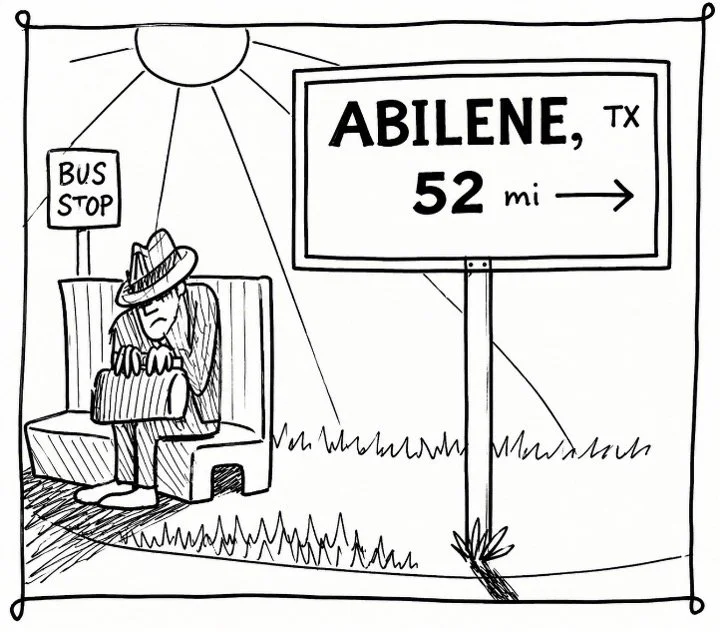
All aboard!!?? Maybe we should talk about this!!!???
~ ~ ~ ~ ~
"The inability to manage agreement, not the inability to manage conflict, is a major form of organizational dysfunctionality."
Henriksen K, Dayton E, quoting Harvey’s “Abilene Paradox” in: Organizational silence and hidden threats to patient safety. Health Serv Res. 2006;41(4 Pt 2):1539-1554.[10]
~ ~ ~ ~ ~
The Trip Nobody Wanted
I can’t remember where I first encountered this story, this almost Dickensian observation about human behavior that we’re going to discuss today.
Maybe it was an undergraduate psychology class? Anyway, that’s not important. Modern interwebs research has told me the story was first told by management and leadership expert Jerry Harvey way back 1974, and it’s the tale of…wait for it!... a trip that nobody wanted to go on.
It’s a groupthink parable that’s known as the Abilene Paradox.[1]
And it goes like this:
On a hot afternoon in Texas, a family sat comfortably on a porch trying to stay cool. Someone casually suggested driving to Abilene for dinner. Nobody was particularly enthusiastic about the idea, but nobody objected either. One person assumed the others wanted to go. The others assumed the same thing. Before long, everyone piled into the car and began a long journey through the Texas heat.
The trip was miserable! The drive was unpleasant, dusty and hot. The food was mediocre, and everyone returned home, tired, hot, and grouchy. Only then did the truth emerge: nobody had actually wanted to go to Abilene! Each person had agreed because they mistakenly believed everyone else wanted to go.
The group had collectively organized itself around a journey that nobody genuinely desired.
Harvey used the story to illustrate a peculiar organizational failure: a tendency for groups to struggle not because they cannot reach agreement, but because they reach agreement too easily! Individuals suppress their true preferences, assume others want something different, and eventually find themselves pursuing goals that nobody truly shares.
The more time I spend in healthcare, the more I think about Abilene.
I think about it because I suspect we’re sending people there every day.
~ ~ ~ ~ ~
The Hidden Danger of Agreement
Turns out, I’m not the only one to see this. In healthcare, the stakes are far higher than an unpleasant road trip! Writing in Health Services Research, Henriksen and Dayton argued that the dynamics described by Harvey represent a genuine threat to patient safety and organizational effectiveness.[10] Their work introduced the concept of organizational silence, which is the tendency of groups to collectively avoid difficult conversations even when important concerns remain unspoken.
In such environments, people may appear to agree while privately harboring doubts, questions, or alternative preferences. The result is a form of collective misperception in which organizations can find themselves pursuing actions that few, if any, participants genuinely desire. If Harvey's Texas family accidentally organized itself around a trip nobody wanted to take, Henriksen and Dayton remind us that healthcare organizations can do the same thing, often with consequences that extend far beyond a disappointing meal in Abilene.
~ ~ ~ ~ ~
The Most Common Trip in Sleep Medicine
Consider a common clinical scenario: a patient visits a primary care clinic because they are tired, snore loudly, have high blood pressure, or simply do not feel well rested. The symptoms may be significant, mild, or somewhat ambiguous. They may be coming from multiple sources. Nevertheless, a reasonable suggestion emerges.
"Maybe we should check for Sleep Apnea."
The patient nods. The clinician nods. The family nods. A referral is placed, a sleep study is ordered, and the journey begins.
At this point, nothing inappropriate has happened. Looking for Sleep Apnea is obviously a good idea! Obstructive Sleep Apnea is common, frequently underdiagnosed, and associated with important health consequences.[2,3] The problem is not the decision to investigate…the problem is that the original question tends to disappear once the machinery of diagnosis begins moving.
Healthcare systems are remarkably efficient at carrying people forward: appointments are scheduled, tests performed, labels assigned, treatment options discussed, and follow-up visits are arranged.
Compliance reports appear and insurance requirements get met. Additional interventions are considered, and metrics are reviewed. In all of this hubbub, though, surprisingly little time gets spent revisiting the most important question of all.
Why are we doing this?
Why are we going to Abilene?...and is it worth it?
~ ~ ~ ~ ~
The Label Takes the Wheel
Modern healthcare is organized around diagnostic labels. Labels are extraordinarily useful! Not gonna lie! Labels allow clinicians to communicate efficiently, researchers to study populations, and healthcare systems to allocate resources. The field of sleep medicine could not exist without shared definitions and diagnostic frameworks.[2,3]
At the same time, labels possess a subtle danger. See, once a label appears, it begins exerting a kind of gravitational pull, the conversation gradually shifting from understanding the patient to managing the diagnosis. The patient arrives with a story, and the system responds with a category.
A patient may say, "I am exhausted." The system replies, "You have Sleep Apnea."
A patient may say, "I wake up with headaches." The system replies, "You have Sleep Apnea."
A patient may say, "I want to feel better." The system replies, "You have Sleep Apnea."
Sometimes that response is entirely appropriate, sometimes not. The challenge is that once the label enters the conversation, the momentum can become difficult to stop.
Researchers have described related phenomena using terms such as diagnostic momentum, preference misdiagnosis, and failures of shared decision-making.[4-6] Although these concepts differ in important ways, they all point toward a common concern. Healthcare systems can become highly skilled at identifying diseases while simultaneously losing sight of whether the proposed intervention aligns with the patient's own goals and values.
In other words, our healthcare system tends to create its own version of Abilene.
Everyone appears to agree. Everyone seems to be moving in the same direction. The journey proceeds. Yet nobody pauses long enough to determine whether the destination actually matters to the traveler.
~ ~ ~ ~ ~
More Roads, Same Question
Mannion and Thompson (2014) describe a strikingly parallel mechanism in healthcare through their analysis of escalation of commitment: a systematic bias in which clinical teams continue investing in a care trajectory despite mounting evidence that it may not serve the patient's interests, sustained by self-justification, social conformity, and reluctance to disrupt apparent consensus. [9] Where Harvey's family ends up in Abilene because nobody voices a private objection, Mannion and Thompson's clinical teams end up locked into diagnostic and treatment pathways because the social architecture of healthcare discourages dissent at every level, from the bedside to the boardroom.
The irony is that this problem becomes more pronounced as medicine becomes more sophisticated. When treatment options were limited, there were fewer roads to travel. Today, patients with Sleep Apnea may be offered positive airway pressure therapy, oral appliance therapy, positional therapy, weight-loss interventions, upper airway surgery, hypoglossal nerve stimulation, structural airway interventions, or combinations of multiple approaches.
Innovation is creating more possibilities than ever before. That is wonderful news! AND…it is also precisely why patient agency matters more than ever before.
The existence of multiple pathways means that the process of presenting “choice” is increasingly important, and that includes the choice not to go traveling at all! Healthcare often behaves as though diagnosis automatically determines destination, the “label” itself becoming the reason for treatment. When the label becomes the justification for action, however, the journey becomes self-perpetuating.
Patients may find themselves riding the bus toward Abilene without ever being asked where they actually hoped to go!
~ ~ ~ ~ ~
The Five Reasons to Treat
The Abilene Paradox played an important role in the development of the Five Reasons to Treat framework, theoretically within the Empowered Sleep Apnea educational project and operationally in the Rebis clinical ecosystem.[7]
The framework emerged from the acknowledgement that a diagnosis does not tell us why a patient wishes to pursue treatment. An AHI does not tell us why a patient wishes to pursue treatment. A reimbursement code does not tell us why a patient wishes to pursue treatment.
Only the patient can answer that question.
The Five Reasons to Treat conversation provides a structured way of asking it.
Risk.
Snoring.
Sleep.
Wake.
Comorbidities.

…some conversations should not be rushed…
The framework is intentionally simple. Its purpose is not to replace medical judgment. Its purpose is to create a checkpoint before the journey begins.
Suppose a patient is diagnosed with Sleep Apnea. What happens next?
At Rebis, the answer is not immediate treatment selection. The answer is a conversation. Which of these reasons matters to you? Are you concerned about long-term mortality risk? Are you trying to reduce disruptive snoring? Are you hoping to sleep more soundly? Are you seeking improvement in daytime functioning? Are you attempting to improve a coexisting medical condition?
The answers may vary dramatically from one patient to another. That variation is not a problem, folks; it’s the whole point!
Viewed through this lens, the Five Reasons to Treat are more than an educational tool, they’re more of an organizational safeguard. They function as an iterative systemic checkpoint against the Abilene Paradox.
Before we board the bus, we pause.
Before we order the intervention, we pause.
Before we commit years of effort, expense, and attention, WE PAUSE!
Then we ask a deceptively simple question: Where exactly are we trying to go?
The answer may reveal remarkable alignment. Occasionally it may reveal disagreement. Sometimes it may reveal that the patient is primarily interested in a destination that has little to do with Sleep Apnea at all.
~ ~ ~ ~ ~
The Goal is NOT Agreement
The purpose of healthcare is not to maximize agreement. The purpose of healthcare is to help people make informed decisions that reflect their own goals, values, and preferences.[4-6] A patient who chooses not to pursue a treatment after a thoughtful discussion has exercised more autonomy than a patient who passively accepts every recommendation placed before them.
This is not just Kum-Bah-Yah, folks; the literature bears this out! A 2026 systematic review by Moffa and colleagues found that patients make treatment decisions based on perceived benefit, comfort, and practicality rather than severity metrics alone.[8] In other words, the thing patients care about isn't necessarily the thing the healthcare system cares about. That's a pretty important observation if your goal is to avoid unnecessary trips to Abilene.
Coerced compliance isn’t a victory for anybody, folks, that’s the point. The goal is engagement, ownership, and agency. Every emerging therapy introduces new opportunities for misunderstanding. Structural airway interventions such as MARPE, advanced surgical procedures, implantable devices, and novel technologies all create exciting possibilities. They also create new opportunities for patients and clinicians to mistake motion for progress.
The more roads we build, the more important it becomes to verify the destination. That is why shared decision-making, transparency, and explicit discussions of goals are not optional features of modern healthcare, but instead are essential safety mechanisms.[3-5]
Without them, the risk is not merely overtreatment or undertreatment. The risk is that we collectively organize ourselves around journeys that nobody consciously chose.
~ ~ ~ ~ ~
Before the Bus Leaves
The original Abilene story remains powerful because it exposes a deeply human vulnerability. Most people do not want conflict. Most people do not want to disappoint others. Most people would rather nod politely than risk appearing difficult. Clinicians are no different. Patients are no different. Families are no different.
The result is that everyone may quietly assume someone else knows where the bus is going.
The great challenge of patient-centered care is to interrupt that assumption, to ask the uncomfortable questions that verify the destination. As clinicians, we must ensure that the proposed journey genuinely serves the person taking it.
At Rebis, the Five Reasons to Treat represent one attempt to build that checkpoint into the process itself…it’s a way of considering…before we travel any farther…that we are not simply planning another trip to Abilene.
Because nobody should spend years traveling toward a destination only to discover they never wanted to go there in the first place.
Kind mojo,
Dave
David E McCarty MD FAASM
Longmont CO
24 June 2026
~ ~ ~ ~ ~
References
Harvey JB. The Abilene paradox: the management of agreement. Organizational Dynamics. 1974;3(1):63-80. doi:10.1016/0090-2616(74)90005-9.
Gottlieb DJ, Punjabi NM. Diagnosis and management of obstructive sleep apnea: a review. JAMA. 2020;323(14):1389-1400. doi:10.1001/jama.2020.3514.
Veasey SC, Rosen IM. Obstructive sleep apnea in adults. N Engl J Med. 2019;380(15):1442-1449. doi:10.1056/NEJMcp1816152.
Ubel PA, Scherr KA, Fagerlin A. Empowerment failure: how shortcomings in physician communication unwittingly undermine patient autonomy. Am J Bioeth. 2017;17(11):31-39. doi:10.1080/15265161.2017.1378753.
Davidson KW, Mangione CM, Barry MJ, et al. Collaboration and shared decision-making between patients and clinicians in preventive health care decisions and US Preventive Services Task Force recommendations. JAMA. 2022;327(12):1171-1176. doi:10.1001/jama.2022.3267.
Saini V, Garcia-Armesto S, Klemperer D, et al. Drivers of poor medical care. Lancet. 2017;390(10090):178-190. doi:10.1016/S0140-6736(16)30947-3.
McCarty DE, Stothard E. The Five Reasons Monument. Empowered Sleep Apnea Project. Available at: https://www.empoweredsleepapnea.com/the-five-reasons-monument. Accessed June 24, 2026.
Moffa A, Nardelli D, Iafrati F, et al. What do patients want for their sleep apnea? A systematic review of treatment choice and preference drivers. Sleep Breath. 2026;30(4):185. doi:10.1007/s11325-026-03703-1.
Mannion R, Thompson C. Systematic biases in group decision-making: implications for patient safety. Int J Qual Health Care. 2014 Dec;26(6):606-12. doi: 10.1093/intqhc/mzu083. Epub 2014 Oct 15. PMID: 25320152.
Henriksen K, Dayton E. Organizational silence and hidden threats to patient safety. Health Serv Res. 2006;41(4 Pt 2):1539-1554. doi:10.1111/j.1475-6773.2006.00564.x.