
Snow White Was Never Waiting for a Prince
OR: The Forest, the Mirror, and the Iterative Work of Showing Up
By David E. McCarty MD FAASM (…but you can call me Dave)
2 March 2026
~ ~ ~ ~ ~
“I do not make films primarily for children.
I make them for the child in all of us, whether we be six or sixty.”
— Walt Disney [1]
~ ~ ~ ~ ~
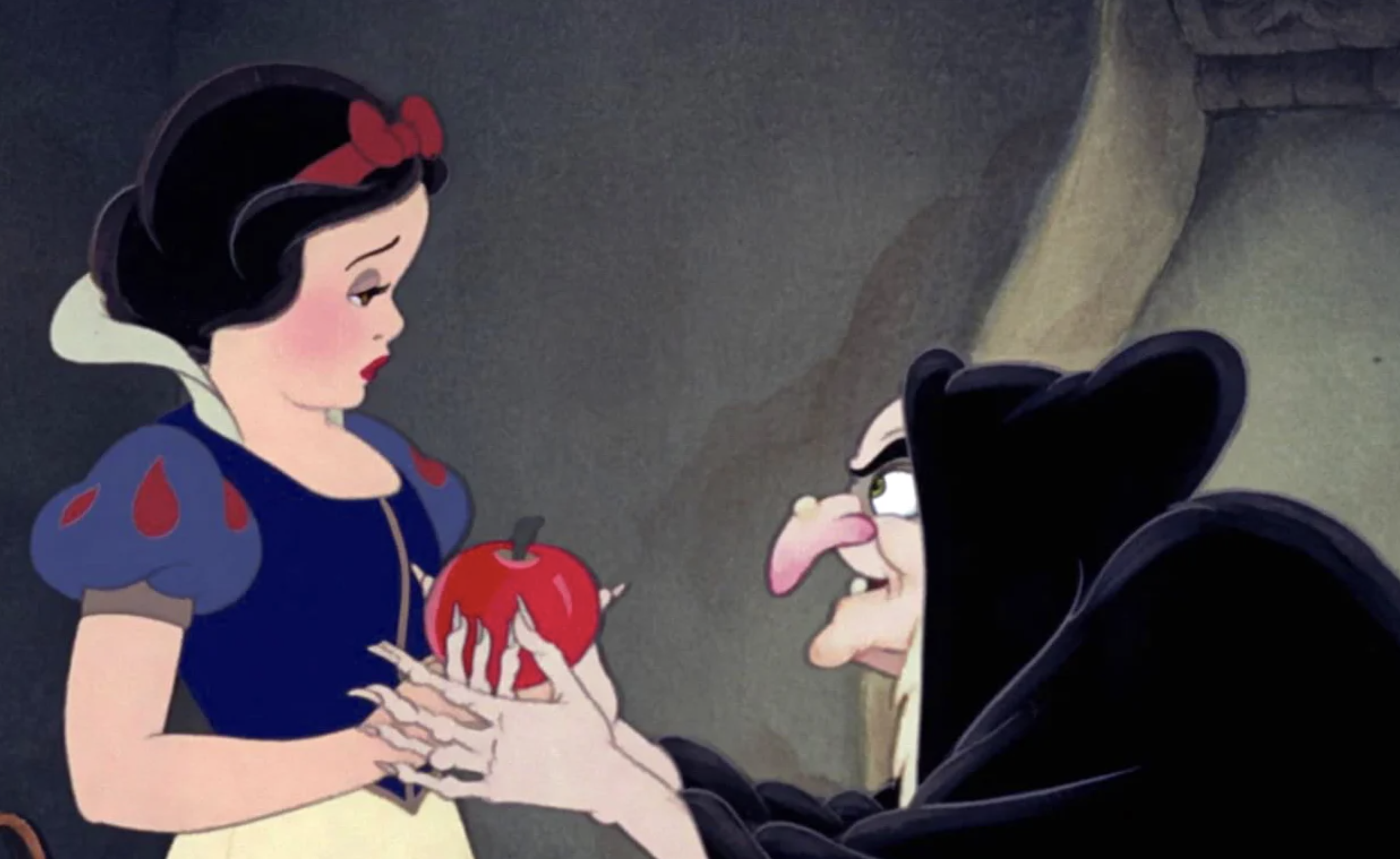
Snow White and the Seven Dwarfs (1937), directed by David Hand, produced by Walt Disney Productions. Image © The Walt Disney Company.
~ ~ ~ ~ ~
I have loved Walt Disney for most of my life.
Just to be clear, I never met the man, so this is not some late-in-life biographical confession. (LOL!). Growing up in Southern California, though, I suppose it’s fair to say that I imprinted on the world he built. For me, Disneyland wasn’t just a theme park — it was an architecture of exploration and delighted curiosity. Disneyland emoted that thing Prince Albert tried to capture in the first World’s Fair: it was a place where the past, the future, and imagination coexisted without apology, and it was all tied together in one cohesive story.
Before Cinderella, before Beauty and the Beast, before The Little Mermaid, there was a film that many in Hollywood dismissed as “Disney’s Folly.” [1,2] They believed audiences would never sit through a feature-length animated film. It was too expensive, they said, which made it risky. And the subject matter? Too unserious.
Despite all of that, Walt Disney mortgaged nearly everything he had just to finish it.
Think about that.
The year was 1937.
America was still reeling from the Great Depression. Banks had failed; jobs had vanished; soup lines and starvation were everywhere. The idea of permanence had cracked, and the structures supposedly there to protect us simply fell apart.
The palace walls just didn’t feel secure anymore.
And into that psychological landscape, comes an ordinary man from the Midwest with a cartoon called Snow White and the Seven Dwarfs, what was to become the first full-length cel-animated feature film ever made and (nearly a hundred years later) a serious testimonial that this was no “folly”.
Here’s the fun part: for years, I watched this show the way most of us did: beautiful girl, jealous queen, poisoned apple, glass coffin, prince, kiss, “happy ever after,” The End. It’s a clear story about good and evil and about how it’s really awesome to have rich friends. This fabled reading of the story has pretty much landed it in the cultural dustbin of patriarchal relics that didn’t age well, like some of the Rogers and Hammerstein musicals.
But lately I’ve been wondering whether we have been reading it too literally. Perhaps this isn’t a story about a victimized innocent, and a dashing moneyed rescuer? Perhaps this is a story where every character in the storyline is…us?
What if “Snow White” is a story about human integration…and aspirational wholeness?
The famed spiritual psychiatrist Carl Jung once wrote, “One does not become enlightened by imagining figures of light, but by making the darkness conscious.”[3] That idea sticks, if you savor it awhile. Because if we read Snow White psychologically rather than socially, the story shifts, significantly.
The Queen is no longer simply a jealous woman, but is the perfectionist ego we’ve all got — the part of us that stands before the mirror asking, Am I the fairest? Am I the best? Am I safe in my superiority? This is the shadow side of Imposter Syndrome. The mirror isn’t a magic object—it’s comparison, image, identity constructed around external validation.
And Snow White?
She is not simply innocence, victimized by dominant power. She is our own unintegrated consciousness, the innocent part of the psyche that has not yet encountered what it means to be fully human.
When the Queen seeks her destruction, it is not merely jealousy. It is the compulsive perfectionist message demanding that image must prevail over authenticity. Seen this way, the attempted murder is psychic self-annihilation.
But Snow White does not die, as we all know. Snow White does something much more interesting.
She flees into the forest.
For Jung, this takes the fever dream into a completely different and salient direction. See, for Jung, the forest symbolizes our unconscious, and fleeing there represents the destabilizing moment when old certainties fail and we are forced to walk without a map.
As everybody knows, this is the interesting bit, because it’s in that forest she encounters the dwarves.
In the film, they’re portrayed as loveable comic relief. But, hold on a minute! These are seven small, earthy, differentiated figures who spend their days mining underground. They literally dig in the dark and extract ore from shadow. If we read this through an archetypal lens, the dwarves become psychic functions — competence and craft (Doc), irritation and pettiness (Grumpy), joy and delight (Happy), social anxiety (Bashful), energy limitation (Sleepy), illness and reactivity (Sneezy), and confusion/lack of clarity (Dopey).
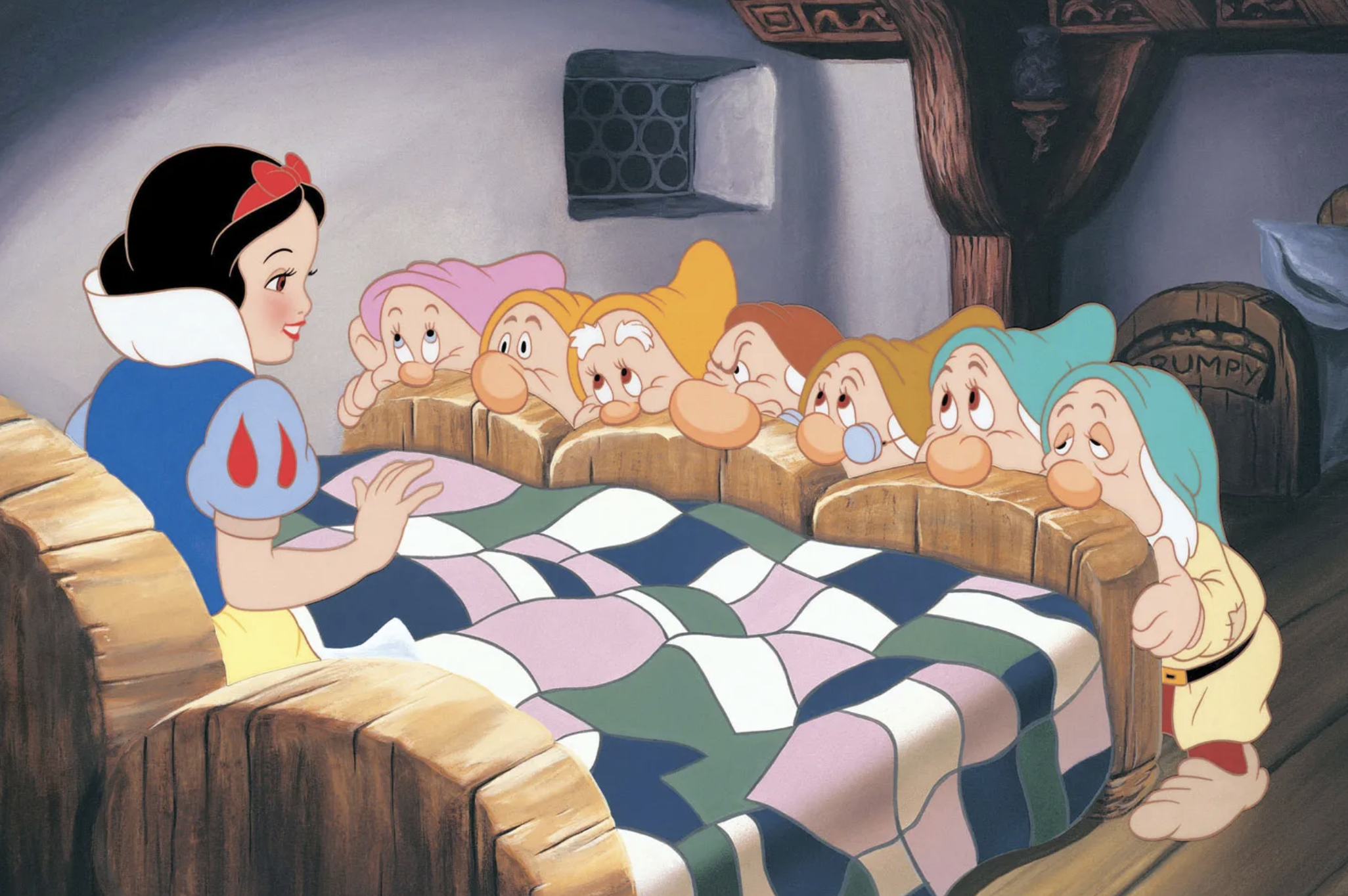
Snow White and the Seven Dwarfs (1937), directed by David Hand, produced by Walt Disney Productions. Image © The Walt Disney Company.
This is not comic relief, anymore folks. This is demonstrative narrative showing us that all of these characters live inside us, all the time.
As everyone knows, Snow White does not conquer these reminders of imperfection. She lives with them, learns to enjoy each for their own idiosyncrasies.
Then comes the apple…
In a moralistic reading, the apple is a symbol of temptation; we learnt that from the Book of Genesis.
When this temptation is taken to a psychological lens, the apple becomes the Queen’s perfectionistic energy internalized — the poisoned belief that wholeness equals flawlessness. That being “the fairest” is safety. That purity protects.
Snow White bites into that apple with the delusion that she’s doing something virtuous (even virtue-preaching can be ego-driven, the story reminds us!), and everything changes.
She freezes.
Here’s where the story gets more interesting. Snow White doesn’t die as a result of this decision; she simply demonstrates what it’s like to embrace that image of perfection to its endpoint. The glass coffin is not death, it’s more like…suspension. It’s a preserved self-image — transparent, admired, untouched by contradiction. Perfectionism does not kill vitality outright; it arrests it. It encases the self in an illusion of clarity while draining it of warmth.
Some of us get caught here in this lifeless life and never return.
Now we see the story differently: the story of Snow White demonstrates that there is another phase beyond this cultural and spiritual ossification. Jung knew about this phenomenon, calling the dark phase of transformation nigredo — the blackening.[4] He characterized it as a period of dissolution, confusion, and withdrawal that precedes integration. Nigredo is not moral failure, nor is it indicative of a victim that needs external rescue.
To Jung, nigredo is the collapse of an organizing principle that can no longer sustain life. In patients, he saw that clinically it’s hard to distinguish from stone cold depression.
Snow White’s stillness can be read this way.
The Queen’s regime — “be the fairest and you will be safe” — has failed. The old identity has poisoned her. Before a new consciousness can emerge, there is suspension. She is visible, but not yet alive in a new way.
This seems to me to be an important part of the story to talk about.
Individuals pass through nigredo.
Institutions pass through nigredo.
Cultures pass through nigredo.
In 1937, America itself was emerging from economic collapse but not yet stabilized. The country was a living experiment of cultural blackening — uncertain whether what had dissolved was permanent ruin or necessary reorganization.
Disney did not deny the darkness.
He embraced it, and gave us a story about descent into shadow and reanimation. He offered a story about a larger human pattern, when permanence felt unreliable.
And, heyo, need I say it?
Here we are again.
When institutions tremble, the psyche looks for control. Control often disguises itself as purity.
“If we could just get this right.”
“If we could just remove what’s corrupt.”
“If we could just be the fairest again.”
The Queen is not merely an individual reflex; we can feel her in our systemic bones. When insecurity rises, mirrors multiply.
But purity is brittle. It promises safety and delivers isolation. Jung warned that what we refuse to integrate does not disappear; it is projected outward.[5] Our shadow denied becomes our enemy. Through this lens, we can see that cultures, like individuals, can freeze when they organize around image, fear, and increasing claims of purity rather than integration.
For much of my life, I believed goodness was protection. I thought that if I were kind enough, clear enough, helpful enough, perhaps I would be safe, relevant, worthy. Recently, I caught myself trying to rise above my own meanness (in a heated moment, I insulted a friend)—I found myself climbing a small internal ladder that began with the mirror of shame and self-loathing.
Instead of that, out of nowhere, I suddenly saw how funny it was, not because it’s funny to insult a friend (it’s not) but because I saw that I had simply experienced a short session with our pal Grumpy. Suddenly, instead of chastising myself silently and doubling down on my virtue, instead of compulsively needing to explain myself, I just laughed--a warm sudden belly laugh. A big ol’ guffaw at how funny it is, that despite all my seriousness and self-work and trying to do the right thing, I still hang out with Grumpy sometimes.
Ha!
And here’s where it gets weird.
As soon as I found myself laughing like that, surprisingly, out of nowhere, I wept like a faucet had been turned on.
Whaaaa? Talk about surprised! These tears didn’t feel like shame, though.
They felt more like grief for how long I had been frozen, for how so many of us suffer from the paralysis caused by the Queen’s apple, one which we choose to swallow for breakfast every day.
Jung wrote, “The shadow is a moral problem that challenges the whole ego-personality.”[6] To see one’s own capacity for darkness without collapsing into self-hatred is not weakness; it is wholeness, beginning.
Through this lens, Snow White is not a damsel awaiting male rescue.
She is a psyche — and perhaps a culture — moving from naïve, perfection-fearing innocence toward self-actualization.
Here’s where the story can step outside its patriarchal past, and we can now see what happens to this human who has moved beyond the mirror, this human who has survived the apple.
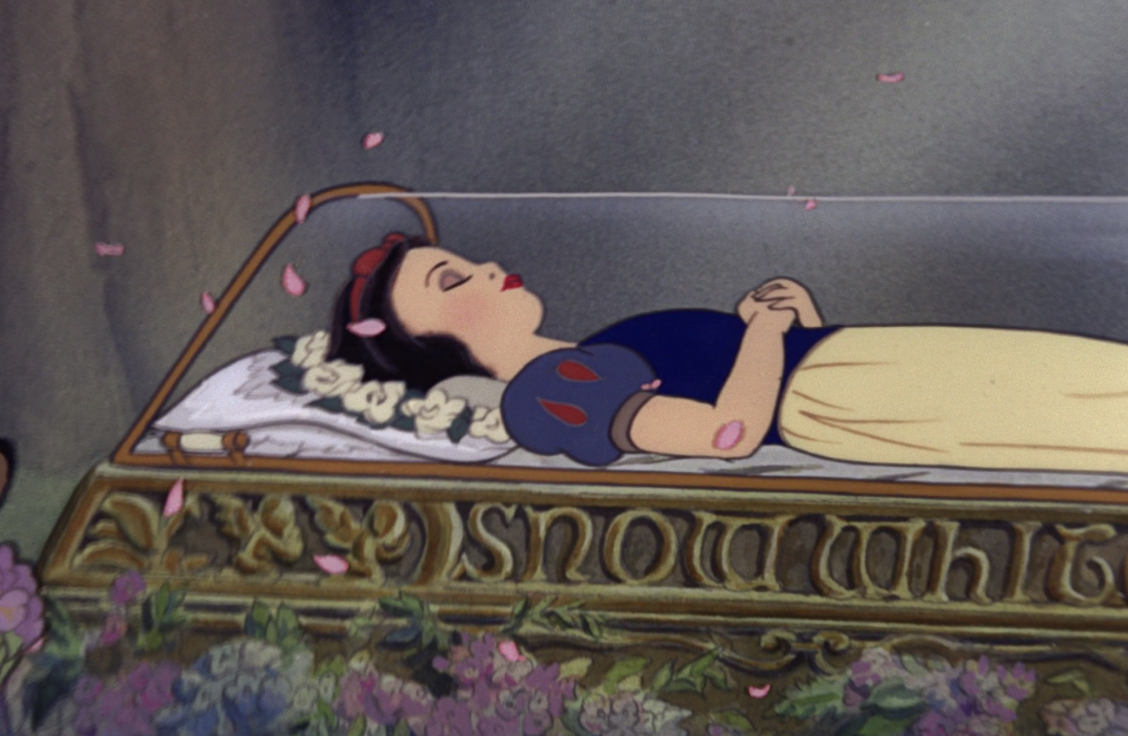
Snow White and the Seven Dwarfs (1937), directed by David Hand, produced by Walt Disney Productions. Image © The Walt Disney Company.
What awakens her is not dominance, but (wait for it…) breath.
If we strip the Prince of patriarchal rescue mythology and read him psychologically, he becomes less a savior and more a spark of consciousness — our own willingness to re-enter the human world without demanding purity first.
In this light, perhaps the kiss is not a single event?
Perhaps the kiss is iterative, and the awakening is our daily practice of engagement.
Each morning, we choose whether to organize around the mirror or around awareness.
Each day, we decide whether to demand flawlessness from ourselves and from one another, or whether to live among the dwarves — the ordinary, imperfect, stubbornly human parts of reality — with warmth instead of fear.
Cultures, like individuals, pass through seasons.
There are moments of innocence, moments of destabilization, and moments of suspension.
The question is not whether darkness exists (we all know it always does).
The question is what we do with our creative energies when it arrives.
Prince Albert gathered industrial upheaval into a cathedral of glass and light for the first World’s Fair. Walt Disney gathered economic despair into a fairy tale about integration. They didn’t do battle with our insecurities; they built containers for us to find our way out.
And here we are again.
If this moment--this strange Fire Horse New Year of friction and falling institutions--is our cultural nigredo, perhaps the question is not who will rescue us.
Perhaps the better question is: What will we build together?
Will we build more mirrors and continue to dine on Queen’s Apple Pie?
Or will we build forests we are willing to walk through, make friends with our humanity, and find a way to engage again with an integrated soul?
Life-Fans, Snow White was never waiting for Prince Charming.
She was living her path toward individuation.
Perhaps we are too.
Kind mojo,
Dave
David E McCarty MD FAASM
Longmont, Colorado
2 February 2026
References
1. Walt Disney, interview (1938), cited in Neal Gabler, Walt Disney: The Triumph of the American Imagination (2006).
2. Richard Schickel, The Disney Version (1968).
3. C.G. Jung, Alchemical Studies, CW 13, §335.
4. C.G. Jung, Psychology and Alchemy, CW 12.
5. C.G. Jung, Civilization in Transition, CW 10.
6. C.G. Jung, Aion, CW 9ii, §14.