
The Wrong Fight: “Providers,” Professionalism, and the Hollowing of Medicine
OR: An Empowered Response to the ACP Position Statement on What We Call Ourselves
~ ~ ~ ~ ~
By David E McCarty MD FAASM (…but you can call me Dave)
12 February 2026
~ ~ ~ ~ ~
“The practice of medicine is an art, not a trade; a calling, not a business; a calling in which your heart will be exercised equally with your head.”
— Sir William Osler in: Address to Medical Students, ca late 1890s
~ ~ ~ ~ ~
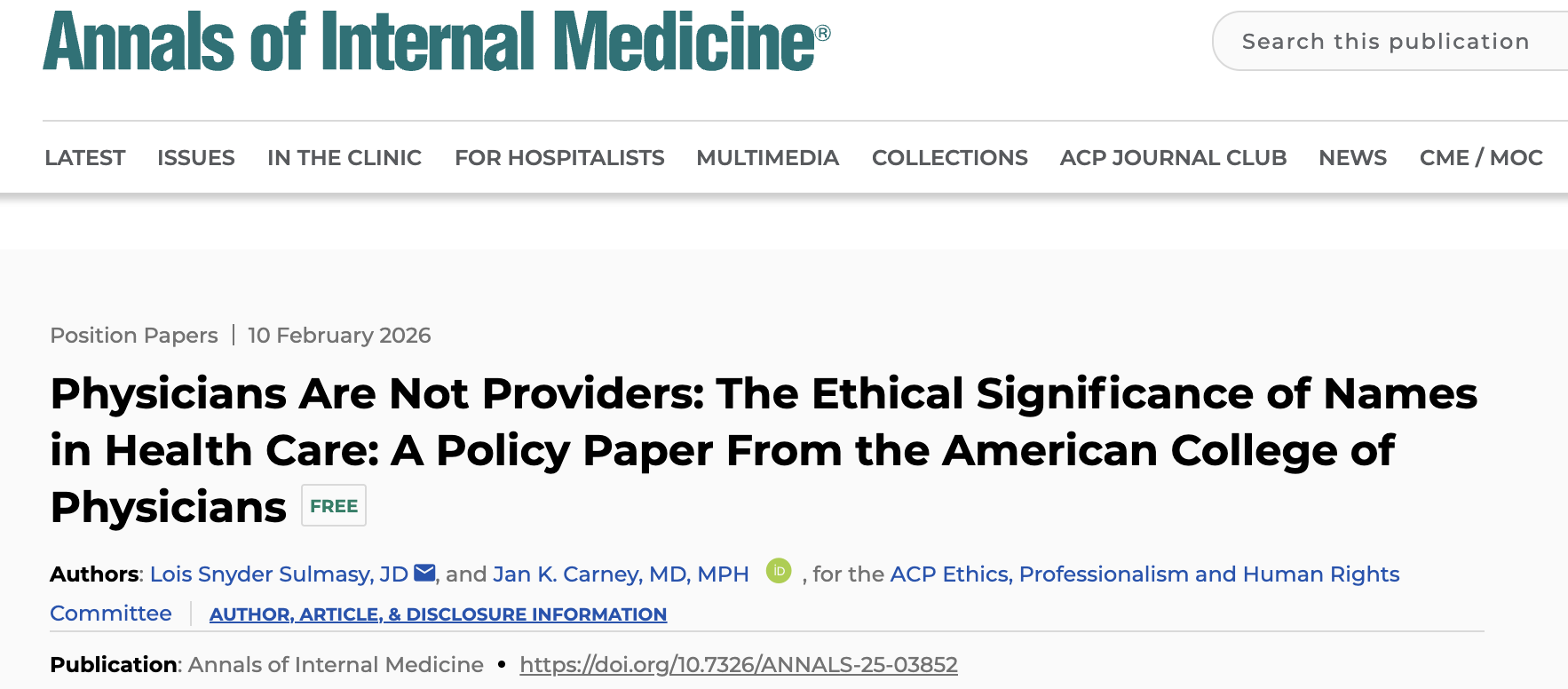
THE PAPER: Sulmasy LS, Carney JK; ACP Ethics, Professionalism and Human Rights Committee. Physicians are not providers: the ethical significance of names in health care. Ann Intern Med. 2026; DOI:10.7326/ANNALS-25-03852.
Just this month, the American College of Physicians published a policy paper in Annals of Internal Medicine arguing that physicians should not be referred to as “providers.” The paper framed the issue not as semantics but as ethics: language, it argued, shapes professional identity, public trust, and the moral character of the physician–patient relationship. [1]
The reaction in medical circles was predictable. Some applauded the statement as long overdue, whilst others dismissed it as a symbolic gesture in a system burdened by far more urgent structural problems.
Life-Fans, from my lens, both reactions miss something important.
I’ll start here: I’ll concede that the debate over the word provider is not trivial. Language shapes perception, and perception shapes behavior. My point in this essay: the controversy risks focusing on the wrong problem…the real issue is not whom or what we call physicians, the real issue is whether the ethical core of medicine is still intact, and (if not) whether we are willing to examine how it has got hollowed out in the first place.
Let’s start with the ethical stance.
That seems noteworthy.
~ ~ ~ ~ ~
The Ethical Claim
The ACP’s argument rests on solid ground, so let’s walk there. It starts as a pushback against the language of transactionalism.
In our hearts, we know that medicine at its best is not merely a technical service. Instead, as Sir William Osler pointed out long ago, it’s a learned and elevated profession, grounded in publicly declared ethical commitments (collectively hearalded as the principles of modern medical ethics): beneficence, nonmaleficence, respect for autonomy, and justice [2]. Ideally, the physician–patient relationship isn’t designed as a commercial exchange but instead as a covenant of trust between a vulnerable person and a trained professional who has pledged to place the patient’s welfare above personal gain.
In that context, the word provider is ethically awkward. It originated in Medicare and Medicaid legislation to designate entities that deliver reimbursable services, and (to that end) it functions rather well. It is less well-suited to describe a human being engaged in a moral relationship with someone who is ill.
Obviously, the term also flattens distinctions. Hospitals, insurance networks, nurse practitioners, physician assistants, dialysis centers, and physicians can all be labeled providers. From an administrative standpoint, this makes sense, but from an ethical standpoint, it obscures meaningful differences in training, scope, and responsibility.
The ACP is right to notice this.
But here is the uncomfortable truth I’m rassling with, Life-Fans: this word did not hollow out medicine…from where I’m sitting, this word arrived after medicine had already begun to lose its way…
Walk with me...
~ ~ ~ ~ ~
A Mirror, not a Cause
Many physicians experience the term provider as a demotion, stepping down from professional to vendor. Somehow though, the deeper question is not whether the word demeans the profession, instead it’s whether (in some domains of medicine) the profession has already drifted toward vendor-like behavior.
In certain specialties—Sleep Medicine is a case in point—clinical practice has increasingly converged on algorithmic throughput. Patients are triaged by standardized criteria, diagnostics are interpreted through narrow numerical thresholds, and treatment pathways are dominated by device-based protocols.
Success is invariably defined by metrics extracted from proprietary software platforms.
When medicine operates primarily as a protocol-delivery system, it begins to resemble precisely what the term provider suggests: a conduit through which products and services move.
I’m not cynical, and I admit this is not universally true. Many clinicians continue to practice deeply relational medicine under extraordinary pressure. However, in specialties heavily mediated by technology and device-driven business models, the shift toward production logic is difficult to deny and hard to address.
Think of it like this: if a clinician’s primary function becomes initiating an auto-adjusting CPAP device and monitoring residual apnea–hypopnea index through cloud dashboards, then the tension between physician and provider begins to look less like “semantic injustice” and more like “diagnostic insight”.
My point is that the language did not create the transformation.
I’m getting the sense that in some cases, it reflects it.
~ ~ ~ ~ ~
Authority Without Craft
Some objections to the term provider are framed as a defense of standards. Physicians undergo longer training and bear ultimate responsibility for complex diagnostic reasoning, so the concern is that collapsing the distinctions between clinicians risks confusing patients and diluting accountability.
That concern is legitimate.
But the rhetoric sometimes carries a different tone to my ears: one of status anxiety. When non-physician clinicians are referred to in the same administrative language, some physicians interpret this as an erosion of authority.
Given all my palavering about patient empowerment, this stance rightfully gives me pause.
My journey has taught me this: authority in medicine should arise from demonstrated competence, ethical integrity, and clinical judgment—not from linguistic hierarchy.
If physicians insist on the title while simultaneously practicing in ways that are rigid, siloed, or algorithm-bound, the defense of nomenclature rings hollow.
Titles cannot substitute for craftsmanship.
In Sleep Medicine, patient presentations are rarely simple. Sleep Apnea intersects with endless other entities, such as circadian misalignment, psychiatric comorbidity, pharmacologic influences, metabolic disease, cardiovascular risk, and behavioral sleep disorders—making a strictly device-centered approach erroneous or even harmful. Practices that focus narrowly on sleep apnea indices while neglecting these interacting domains don’t really exemplify professional mastery anymore, but instead a reductionistic silo.
Our patients, as it turns out, do not experience our titles.
Our patients experience our behavior.
~ ~ ~ ~ ~
The Medical–Industrial Feedback Loop
The term provider gained traction in an era of corporatization and consolidation. Electronic health records measure productivity in relative value units, insurance contracts define reimbursement categories, and device manufacturers generate dashboards that convert physiology into performance metrics.
Within this environment, the language of production and delivery becomes normalized, seeping into administrative vocabulary—and eventually into self-concept.
Language influences identity and identity influences behavior…the more we internalize the role of “service deliverer”, the more our decision-making aligns with throughput and metric compliance rather than integrative, patient-centered deliberation.
That said, we all know that the system is not an external villain imposed upon a pure profession. Physicians participate in and often benefit from these structures. Many of us have adapted comfortably to them.
Accepting this, we see that the ethical tension is not merely external coercion.
Some of it’s because we’re all sort of used to all of this, and some of us like it.
~ ~ ~ ~ ~
What Patients Actually Want
Patients rarely debate terminology like this, when they find someone who’s taking care of them. They care about clarity, competence, compassion, and honesty. They want clinicians who listen carefully, explain uncertainty, and exercise independent judgment rather than reflexively following templates.
Anyone who’s been in the role of patient wants someone who sees the whole person—not merely the index value.
Whether that clinician is a physician, nurse practitioner, or physician assistant matters less than whether that clinician practices in a manner consistent with professional ethics.
This is not an argument for erasing distinctions in training. It is an argument for aligning titles with substance. A profession is defined not by exclusivity but by adherence to publicly declared ethical commitments.
If those commitments are not lived, the title loses credibility.
~ ~ ~ ~ ~
The Right Fight
There is nothing wrong with defending the dignity of a profession: words matter, titles matter, and clear distinctions in training/responsibility matter for patient safety and accountability.
However, when the energy of the debate centers primarily on status rather than substance, it risks appearing self-protective and ultimately self-serving.
My sense is that the more courageous fight is not over what we call ourselves.
The more courageous fight is over how we practice.
If physicians want the public to see a difference between physician and provider, the difference must be visible in the room: in the questions asked, in the integration of complexity, in the refusal to reduce a person to a metric, in the willingness to challenge flawed assumptions—even when those assumptions are embedded in widely accepted technological platforms.
Professionalism is not a badge. It is behavior that acknowledges the narrative behind the label.
Physicians should be called “physicians”. I’ll give that point to the ACP, because it’s reasonable.
The way I see it though, if the profession wishes the term to carry moral weight, it must ensure that the weight is deserved.
The most effective rebuttal to reductive terminology is not protest.
It’s practice.
Physicians should be the teaching champions for Narrative Based Medicine, to show the rest of the providers how it’s done.
Kind mojo,
Dave
David E McCarty MD FAASM
Houston, Texas
12 February 2026
Reference
Sulmasy LS, Carney JK; ACP Ethics, Professionalism and Human Rights Committee. Physicians are not providers: the ethical significance of names in health care. Ann Intern Med. 2026; DOI:10.7326/ANNALS-25-03852.
Beauchamp, T. L., & Childress, J. F. (1979). Principles of Biomedical Ethics. New York: Oxford University Press