
The Nose Rules!—Especially During Cold & Flu Season!!
OR: How We Learned to Stop Worrying and Love Our Noses
~ ~ ~ ~ ~
By David E McCarty MD FAASM (…but you can call me Dave)
&
Ari Walter MD
5 February 2026
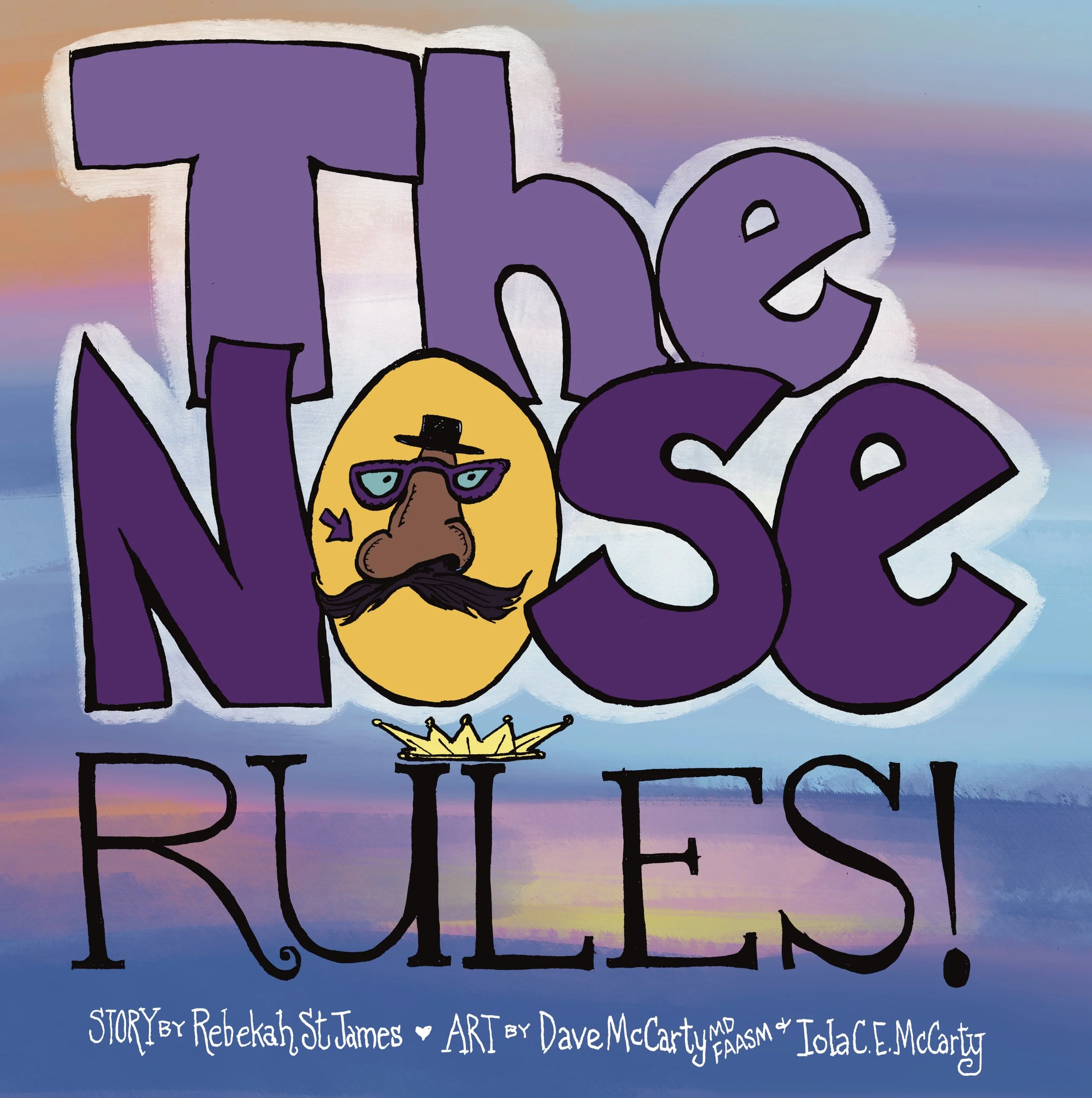
THE NOSE RULES! The COVER art for St. James, McCarty & McCarty (2025)
~ ~ ~ ~ ~
“Instructions for living a life:
Pay attention.
Be astonished.
Tell about it.”
— Mary Oliver, excerpt from “Sometimes,” in: Red Bird (Beacon Press, 2008)
~ ~ ~ ~ ~
A Familiar Feeling
Hey—you.
Yes, you.
Are you getting a cold?
You know the moment. It’s not dramatic enough to cancel your day, but it’s unmistakable once you’ve lived in a human body long enough. A faint scratch in the throat. One nostril that suddenly decides it’s taking the afternoon off.
Most of us respond the same way--we push through and we try to ignore it. We wonder if we need to stay home from work or school. We fight back the collective memories of Covid shutdowns and quarantines.
This year, cold season brings something different. For us, we’re using cold season as a reminder to talk about something most doctors might never mention.
We want to talk about your nose.
Because (as Mary Oliver might note) we’ve been paying attention to it…and it is astonishing!
~ ~ ~ ~ ~
Your Nose Is Not a Hallway
Here’s the thing we want to say plainly, right up front:
**Nasal breathing isn’t just about comfort. It’s part of your immune system.**[1]
For most of us, the nose has been framed as a passive structure. A hallway. Air goes in, air goes out. It warms the air. It humidifies it. It filters particles.
All of that is true.
It’s just incomplete.
The nose isn’t just a hallway, it’s more of a frontline outpost! It’s where the outside world meets living tissue. It’s where decisions get made—quietly, continuously—about what gets through and what doesn’t.
And one of the most important players in that process is a molecule most people have never associated with breathing at all.
Ladies and gents, let us please introduce…the molecule that needs no introduction: Nitric Oxide (NO).
~ ~ ~ ~ ~
Nitric Oxide: Quiet Infrastructure
In humans, the paranasal sinuses continuously produce NO in remarkably high concentrations.[1] This NO plays multiple roles in airway biology, including antimicrobial and antiviral activity and stimulation of mucociliary clearance.[2.3.4]
But NO doesn’t just stay in the nose. When we breathe through the nose, small physiologic amounts of NO are inhaled into the lungs with each breath.[1] Once there, NO selectively dilates blood vessels in well-ventilated alveoli, improving ventilation–perfusion matching and arterial oxygenation.[1]
This is why nasal breathing isn’t about “getting more air.”
It’s about using the oxygen we breathe more efficiently.
Researchers have described this phenomenon by calling nitric oxide an “aerocrine” messenger—a gaseous signaling molecule produced in the upper airways and delivered downstream with inhalation.[1]
Here’s the deal, though, folks: when we mouth-breathe, we bypass this system.
Is that catastrophic? No.
But it’s a bit like having a really expensive burglar alarm, and deciding to leave the alarm off and the front door wide open…
~ ~ ~ ~ ~
When the Nose Feels Blocked
This brings us to congestion. When our nose gets congested, we simply can’t use it! Nasal breathing, as good as it is, can become an impossibility. We reach for decongestants, nasal sprays, nasal steroids, all at a physiologic cost. Oral decongestants can keep us awake and even spike the blood pressure. Nasal decongestant sprays are irritants and are notorious for rebound rhinitis (“rhinitis medicamentosa”). Nasal steroids can also cause nose bleeds.
Wouldn’t it be great if there was a better way to get our nose working?
…cue Steve Miller’s “Big Ol’ Jet Airliner” as our essay-jet flies across “The Pond” to the green grassy fields of Ireland…
~ ~ ~ ~ ~
The Nose Unblocking Exercise
The Irish Buteyko Breathing advocate and teacher, Patrick McKeown, describes a nose unblocking exercise that we really like in his new book The Oxygen Advantage. Learn to do this, and you’re empowered to temporarily reduce nasal congestion and restore nasal breathing.[6] This cold and flu season, you’ll be ready! We’re here to show you how to do it and why it works!
First of all: a precaution.
This exercise is designed to produce a small physiologic stress response at the end of a breath hold, not unlike a jump-scare or a drop on a rollercoaster. If you’re very pregnant or have an unstable cardiac condition where a jump scare feels risky, don’t do this without supervision. Otherwise: let’s decongest!!
The exercise begins with calm nasal breathing. You take a small, quiet breath in through your nose, followed by a small, quiet breath out through your nose--nothing forced or dramatic. You’ll breathe out all your air, and then you’ll hold there.
After the exhale, you gently pinch your nose closed with your fingers and hold your breath.
This is not a maximal breath-hold. The goal is not endurance or toughness. The goal is to create a moderate, tolerable air hunger, and then allow your body to respond.
While holding your breath, you may take a few slow steps if that feels comfortable, or simply remain standing. The point is to let yourself hang out there at the end of expiration, just until you feel a moderate urge to breathe, a slight twitch of the breathing muscles. When this happens, release your nose and resume breathing only through the nose.
Your first breath may be larger than normal. That’s expected. What matters next is recovery. The idea is to calm the breathing as quickly as possible. The second and third breaths should be deliberately softened. Normal nasal breathing should return within a few breaths.
If breathing feels erratic, heavy, or out of control, the breath-hold was too long.
After resting for a minute or two, the exercise can be repeated gently. McKeown teaches a small series of repetitions rather than a single heroic attempt for the best results.[6]
The aim is not domination.
The aim is restoring nasal patency and calm breathing.
~ ~ ~ ~ ~
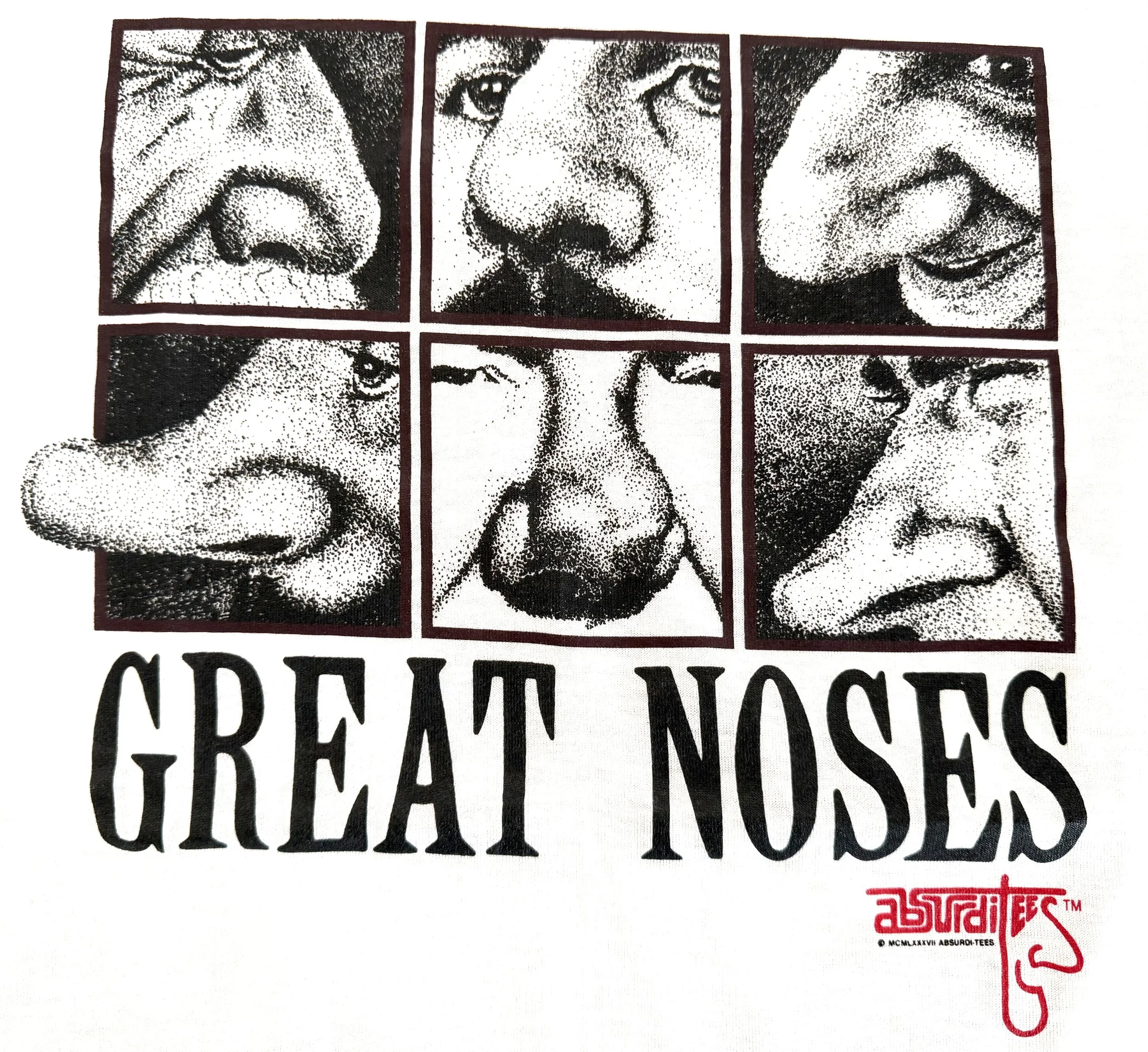
“GREAT NOSES” Art by Jackie Skryzynski, T-Shirt by AbsurdiTEES, Albany NY © 1987
TOP (L-R) Albert Einstein, Ringo Starr, Jimmy Durante; BOTTOM (L-R) Cyrano de Bergerac, W.C. Fields, Richard Nixon
Why This Works
This exercise works through several overlapping physiological mechanisms.
First, there is a mechanical effect. Pinching the nose compresses the erectile tissue and the extensive sinusoidal venous network within the nasal submucosa. These vessels act as large-capacitance reservoirs, and brief compression can temporarily reduce local blood volume and tissue swelling.[7]
Second, there is a chemoreceptor-mediated reflex. Breath-holding raises arterial carbon dioxide levels. Studies show that 30 seconds or more of breath-holding and hypercapnia may produce variable reductions in nasal resistance.[8] This reduction occurs through both mucosal vascular effects and increased activation of the alae nasi muscles, which mechanically widen the nasal vestibule and reduce airflow resistance.[9]
Third, if the breath-hold approaches the point of involuntary breathing movements, a stress response is triggered. Circulating catecholamines—particularly norepinephrine—rise substantially. [10] This catecholamine surge produces systemic sympathetic effects, including nasal mucosal vasoconstriction and reduced sinusoidal filling, which can further restore nasal patency. [11]
This exercise works best early—when congestion is just beginning, when one nostril feels sluggish, when the system is still flexible.
It’s not a cure. It doesn’t prevent every illness. And it’s not a substitute for rest, hydration, or medical care when those are needed.
But it can help restore nasal breathing, which in turn supports nitric oxide delivery, oxygen efficiency, and calmer respiratory patterns.
Think of it as having a triple-acting decongestant, always available, literally at the tips of your fingers, 24/7.
That’s a meaningful thing.
~ ~ ~ ~ ~
Call to Action
So, as we sail into yet another cold & flu season, let’s take a moment and thank our noses…it feels empowering to know we’ve got built-in features that help keep us healthy…this is our little reminder to everyone about what we mean when we say this:
The Nose Rules![12]
So, keep your nose open, keep that nitric oxide from the paranasal sinuses flowing, and stay healthy out there, Life-Fans!
We think that’s advice you can’t really sneeze at!
If you think so too, well, please LIKE and SHARE…or as Mary Oliver said: Pay attention, be astonished, and tell about it!
Kind mojo,
Dave & Ari
David E McCarty MD FAASM
Ari Walter MD
Dr. David E McCarty is the co-creator (with Ellen Stothard PhD) of the Empowered Sleep Apnea project the co-creator (with Rebekah St. James and Iola C.E. McCarty) of THE NOSE RULES! children’s book, and the CMO of Rebis Health.
Dr. Ari Walter is a board-certified Sleep Medicine physician and educator at Rebis Health.

THE NOSE RULES!!~ Image from [12] St. James, McCarty & McCarty (2025)