
INSTANT SLEEP APNEA: Just Add Complexity!
By David E McCarty MD FAASM (…but you can call me Dave)
12 September 2026
~ ~ ~ ~ ~
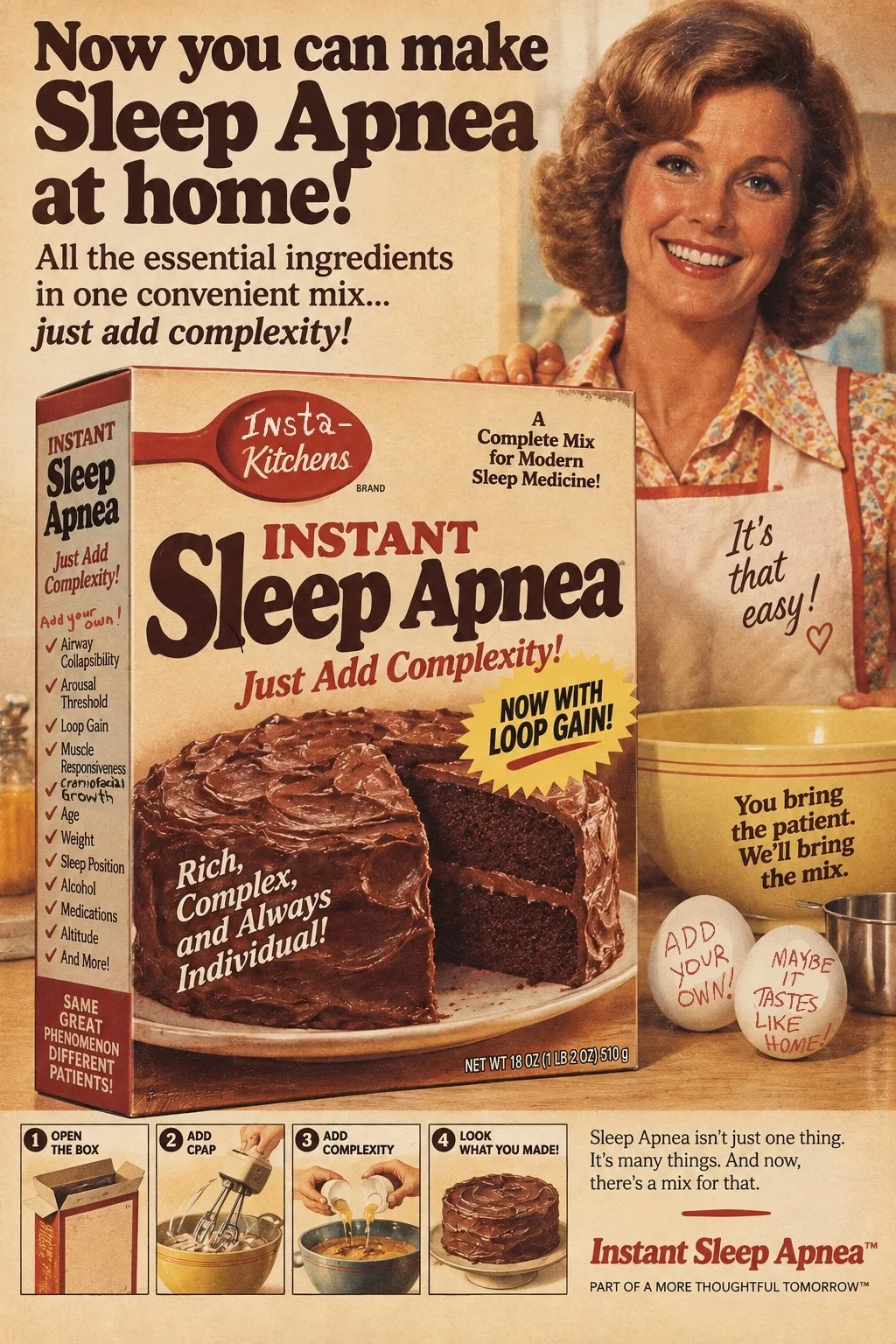
PART OF A MORE THOUGHTFUL TOMORROW! (instant Sleep Apnea graphic by ChatGPT and DM)
~ ~ ~ ~ ~
“All right, if you feel that bad about it, add your own eggs.”
—Ernest Dichter, psychologist and pioneer of motivational research, describing the marketing logic behind postwar instant cake mixes.[1]
~ ~ ~ ~ ~
Betty Crocker goes to the Psychologist
There is a strange and condescending genius to the boxed cake mix.
You know what I’m talking about, don’t you? Someone else did nearly all the work…the right kind of flour has been sifted and measured…the sugar is already in there, the messy business of baking seemingly reduced to a few simple instructions printed on the back of a box.
And yet, somehow, you still get to feel like a cook!
Crack an egg, add some milk, and stir!
HUZZAH! Look what you made!
The story behind this fabled kitchen-dance has become marketing folklore. Ernest Dichter, the Viennese-born psychologist and pioneer of “motivational research,” studied the strange psychology of convenience foods in postwar America.
Yup. You read that right, Life-Fans! This is Betty Crocker on an AM Radio Call-In show, oversharing and telling us everything.
In his work, Dichter found something a little counter-intuitive. Consumers wanted convenience, but not necessarily the feeling that came with too much convenience, if you get my drift. Dichter found that if you just had to add water, it all felt…wrong! Instead, if you left something for the baker to contribute, opening a box could still feel a little like cooking.[1]
Cracking that egg restored a small act of authorship.
Well, thinking about all of this is how I started to wonder if whether we haven’t created something similar in Sleep Medicine…walk with me…
Everybody knows that we need something beyond the metrics…something beyond the AHI as a way to capture what’s going on…
And now here we are:
“Instant Sleep Apnea: Just add complexity.”
Aw geez.
Here we go…
~ ~ ~ ~ ~
Sleep Apnea is Not ONE THING
I’ll start here: That thing we all go around calling “Sleep Apnea” out there in the wild blue is an astonishingly complex biological phenomenon.
Think about it: a sleeping human has interruptions to normal breathing, over and over again…
Why?!
Well, that’s easy! (isn’t it??) The answer may involve the collapsibility of the upper airway…which (itself) may involve craniofacial development and anatomy…it may involve upper airway soft tissue anatomy (and function!)…it may involve obesity…
…it may involve the posture of breathing (nasal vs oral) and it may involve sleep stage or body position…
…it may involve central nervous system arousal threshold (which is, itself, provoked by countless sources)…it may involve the responsiveness of upper-airway muscles, or the stability of the respiratory control system…
…it may involve medications, alcohol, cardiac function, circulation time, or even (gasp!) the composition of the atmosphere itself…
Whew!
But if that ain’t enough, there’s still more! It’s not uncommon for MORE THAN ONE element to be active in a given case!
Despite this vast complexity—perhaps to try to make peace with it--we’ve taken this extraordinary physiologic stew and done something remarkably efficient with it: we put it in a box.
OBSTRUCTIVE SLEEP APNEA.
Then we put a number on the box.
AHI: 23.
Then we provide instructions.
Just add CPAP!
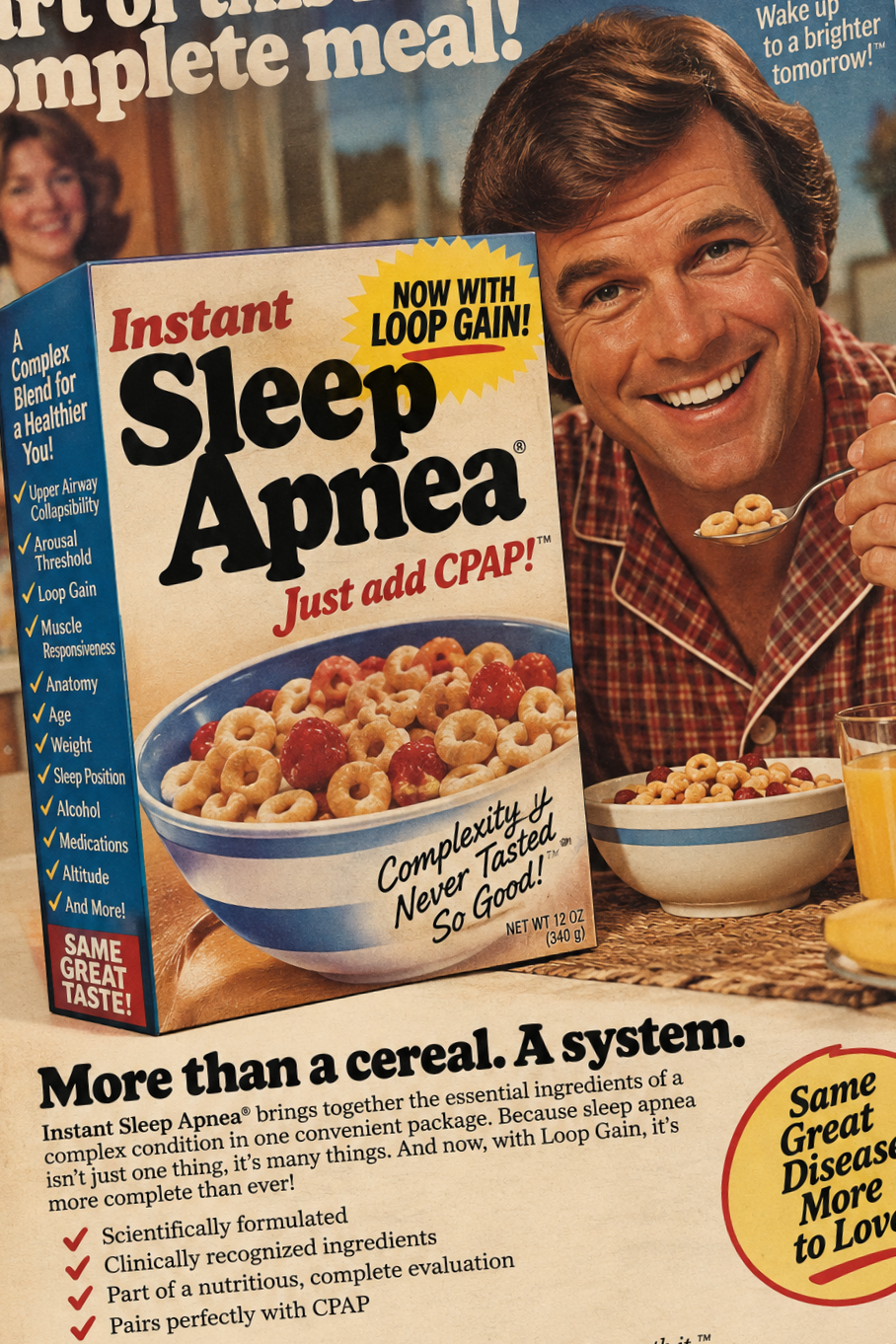
PART OF THIS NUTRITIOUS BREAKFAST?
Sound crazy? Maybe so. But we didn’t get here by being foolish! Nay! Standardization in scoring and achieving a centralized concordance for diagnostic criteria were important steps! The apnea-hypopnea index gave us a common language, and it’s even been s-t-r-e-t-c-h-e-d to acknowledge that hypopneas should capture non-O2-desaturating events. Bravo!
Sharing a diagnostic criteria is foundational, because it helps us identify and study populations we care about, allowing us to critically evaluate what we’re doing for them.
It means we’ll regard our therapeutic recommendation with a critical eye as we try to decide if it’s of any value for our patient.
Will this therapy help me, doc? That’s the question our patients have for all of us.
Don’t get me wrong! I like convenience. The boxed mix exists for a reason—it’s sscalable, reproducible, teachable and measurable.
And it often makes a pretty good cake!
The problem begins when we mistake the box mix recipe for the meal we intended to deliver.
All of which begs the question: what’s the patient hungry for?
~ ~ ~ ~ ~
MANY MOVING PARTS and Simplistic Treatment Plans
In 2025, the American Thoracic Society published a research statement that should make all of us involved in Sleep Apnea care sit up a little straighter. The authors stated plainly that the pathogenesis, manifestations, and consequences of obstructive sleep apnea “vary markedly among patients,” while this heterogeneity remains largely unaddressed in current management pathways.
YES!!! Over here at The Isle of Sleep Apnea, we just go ahead and admit that this beast has MANY MOVING PARTS.
It really shouldn’t shock anybody that failure to grasp the complexity of a problem often leads to failure of remediation strategies! The ATS statement acknowledges Sleep Apnea treatment failure rates at approximately 50%.* [2]
*(N.B.:“failure” here is a broad estimate encompassing problems such as PAP nonadherence and residual disease—there was no single standardized definition of “treatment failure”).
The point is: we’re not doing well, and the literature is piping up! One review describes conventional management as a CPAP-focused, “one size fits all” trial-and-error approach that is too frequently inadequate for many patients.[3] Another notes that OSA care has historically not been personalized, with most symptomatic patients simply receiving CPAP as the only answer.[4]
All of this got me thinking about the complexity of this beast, and the sequencing of how we roll that out…
The complexity is present at the beginning, you know? With our rules and our scores, we simplify it. Then: we treat the simplification. When treatment fails, ONLY THEN do we become interested in the complexity!
Why can’t this patient tolerate PAP?
Why does another remain exhausted when the machine says the AHI is normal?
Why did central events appear?
Why does Sleep Apnea change when a patient travels?
Why does position matter so much?
Why does an oral appliance work beautifully for one person and make things worse for another?
Each time the patient fails, we check the ingredients! What was in THIS box? Suddenly, depending on where we are, we may be interested in anatomy. Phenotype. Endotype. Loop gain. Arousal threshold. Muscle responsiveness. Hypoxic burden. Position. Nasal resistance. Medications. Insomnia. Altitude. Symptoms. Goals. Preferences.
Which ingredients are important? How do we know what to look for?
Who knows?!! Depends on the shop!
Everywhere, in clinics all over the world, folks are adding individual complexity ingredients back into the box, hoping for that taste that all patients crave! [TM]
For the patient bouncing from recipe to recipe, it’s not hard to imagine that the whole system can begin to feel like a massive game of bait-and-switch…
~ ~ ~ ~ ~
The Scores We Abide By
The number printed on the box deserves another look.
Our beleaguered AHI has been extraordinarily useful, but it’s inadequate as a singular gauge of Sleep Apnea’s vast complexity.[12] Two people can have the same AHI whilst experiencing respiratory events that are different in duration, depth of desaturation, clustering, physiologic consequence and compensatory pathways, and symptom burden.
Folks, this distinction is no longer theoretical! The AHI simply doesn’t help us in the way that it’s supposed to!
Reviews of OSA heterogeneity increasingly caution against treating AHI as though it were a complete representation of disease severity or prognosis.[6,7] We now know that hypoxic burden [13] captures dimensions of Sleep Apnea that AHI does not and that it’s way more reliable (compared with AHI) at predicting cardiovascular and all-cause mortality.[5-7]
None of this makes AHI useless, it just makes it incomplete.
A measuring cup is useful in a kitchen, no doubt!
It’s simply time we looked more closely at the ingredients we’re putting into it.
~ ~ ~ ~ ~
Altitude Cooking is Different
Let’s consider something as banal as altitude.
Much of what we’ve learnt so far about Sleep Medicine has come from academic meccas, like Stanford and Harvard. Awesome places, but close to sea level.
When you train at a place like that, you might get the idea that altitude isn’t really something to worry about. Up here in Denver Metro and Rocky Mountain-land, I’d beg to differ![19]
Folks, I did some digging, and it turns out: we’re not alone! Geospatial population and elevation data estimates put approximately 500 million people worldwide at or above 1,500 meters (~ 5,000 feet) above sea level.[8] That’s about one in fifteen, worldwide, folks.
For ~500 million of our fellow humans, altitude is not an adventure, a ski vacation, or a laboratory experiment.
Moderate- to high-altitude is where 500 million humans go to bed.
And let me tell you, folks, altitude matters to breathing.[19]
As barometric pressure falls, hypoxic ventilatory drive increases. Ventilatory control can become less stable, promoting periodic breathing and central respiratory events. A person does not carry a fixed quantity of “obstruction” around like something stamped on a passport. Change the environment, and the expression of sleep-disordered breathing will reliably change with it.
Latshang and colleagues demonstrated this in a randomized trial of patients with OSA traveling to altitude. Adding acetazolamide to autoCPAP improved nocturnal oxygenation and reduced breathing disturbances compared with autoCPAP alone.[9] The effect was altitude-dependent and should not be exaggerated: the median AHI reduction attributable to acetazolamide was approximately 3 events per hour at 1,630 meters and 9 events per hour at 2,590 meters. More revealing still, the reduction was driven mainly by fewer central apneas and hypopneas.[9]
The pneumatic splint was addressing one moving part. Acetazolamide was addressing another. The point is not that everyone with Sleep Apnea needs acetazolamide.
The point is that the atmosphere itself can be one of the moving parts.
Which brings us, improbably, back to cake mix.
Anyone who has baked in the mountains has seen the little section printed on the box:
HIGH ALTITUDE DIRECTIONS.
Even the cake-mix people understand that the same ingredients can behave differently when you change the environment.
~ ~ ~ ~ ~
What’s Your Endotype?
There is a growing movement in Sleep Medicine toward phenotyping and endotyping Sleep Apnea.
We now recognize that upper-airway collapsibility is only one part of OSA pathogenesis. Nonanatomic contributors can include unstable ventilatory control, such as a low arousal threshold or impaired pharyngeal dilator muscle responsiveness.[2,10] Increasingly sophisticated approaches to sleep-study data may allow us to extract physiologic information that a simple event count cannot provide.
This is exciting work, but: HOLD! There’s danger here, too!
Depending on the clinic, are we just offering a more sophisticated boxed-mix?
Is it the same old process, but NOW WITH LOOP GAIN! (Crack an egg. Look what you made! HUZZAH!)…
Is this just the opening ceremonies at the bait-and-switch Olympics?
Clearly, we needed something less reactive, something more future-facing than that at Rebis Health, which meant that Empowered Sleep Apnea project needed a new and future-facing lexicon for how we are going to talk about this thing.
The task was to bake the complexity into the very language that we use! See, when we define a phenomenon by naming its presumed mechanism, we predictably narrow the questions we ask next.
Here’s what I mean: when I tell you that a patient has obstructive sleep apnea, the label has already limited what we see! Within that diagnostic label, I’ve offered a simple mechanism: airway obstruction.
Folks, that explanation may be substantially correct! Heck, it may even be the only thing going on! (hey! It happens, but it’s rare!).
For many of us, though, “airway obstruction” is only one piece of a much larger transdiagnostic journey. Once we’ve embedded a mechanistic label into the name of the disease, our understanding of the patient’s lived experience shrinks, a bit.
The EMPOWERED approach? Let’s stoke our curiosity, from the very beginning, to work against the label!
Let’s choose words that help us find our way...
~ ~ ~ ~ ~
The Operational Definition of Sleep Apnea
The idea for a system-wide “Operational Definition” of this thing we call Sleep Apnea comes from a phenomenon-first framework I introduced in a January 2026 essay as the Three Stars of Empowerment: three questions intended to preserve complexity and orient the patient-centered, NARRATIVE-based journey, before diagnosis hardens into assumption.[11]
Empowered Sleep Apnea’s OPERATIONAL DEFINTION of SLEEP APNEA [11]
· Sleep Apnea = “unstable breathing” during sleep that negatively impacts health or well-being.
· The instability comes in two “flavors” (obstructive and central)
· The contribution of each flavor is expected to change across time, altitude, position, posture, age, and other circumstances (i.e.: each flavor has MANY MOVING PARTS...)
An operational definition does something deceptively modest: it describes the phenomenon before pretending to know its cause. A person experiences recurrent episodes of reduced or absent breathing during sleep. Fine! Now the interesting work begins.
What is driving this?...Craniofacial anatomy?...High altitude?...The open-mouth breathing posture? The prolonged circulation time of atrial fibrilation? Over-ventilation from the PAP machine itself?
Some, or ALL OF THE ABOVE???
What MOVING PARTS might be contributing? What else could explain this person’s symptoms?
Then, perhaps, most importantly: why does this particular person need to have this unstable breathing pattern stabilized? What are the goals? What are we trying to accomplish together?
Notice what’s happened, here, with our simple, yet subtle change of language. We have not made Sleep Apnea more complicated. We’ve simply stopped subtracting complexity at the moment of diagnosis.
Folks, this distinction matters because, in real time we don’t yet know…that which we don’t yet know! It’s one of the bugaboos of managing a complex problem! It’s why we’re so tempted to collapse this problem into something easy, like an AHI, or a potentially misleading “label”, like “MILD”.[18]
The ATS statement states\ that endophenotyping remains largely confined to research. Clinically validated cutoffs, reproducibility across populations, minimal clinically important differences, and evidence that endotype-guided pathways improve meaningful outcomes remain works in progress.[2] Turnbull and Stradling asked the appropriate question in the title of their review—Are We There Yet?—and the honest answer remains: not yet.[4]
Precision medicine is still becoming…medicine. My point is that acknowledging complexity and measuring every single component of it are not the same thing.
For the Rebis clinical ecosystem, I’m preserving the right to ask the right questions, at the right time. I see our shared complexity management as an end to the “bait and switch” charade.
The way I see it, treatment failure should not be the admission ticket to curiosity.
~ ~ ~ ~ ~
A Meal, Cooked from Scratch
There is another important difference between instant food and an actual meal: a meal cooked from scratch often begins with healthy appetite!
What does this person want? What does this person need? What ingredients do we have? What will work together? What should we avoid? What environment are we cooking in?
In The Three Stars of Empowerment, I proposed three questions as navigational landmarks for precisely this kind of patient-centered journey, the Three Stars We Sail By: [11]
What is Sleep Apnea?
What else could this be?
Why should we treat it?

THE THREE STARS OF EMPOWERMENT…
The first question prevents us from mistaking a diagnostic label for an explanation, reminding us that our Operational Definition of Sleep Apnea allows more precise problem-solving.
The second question keeps our transdiagnostic “Five Finger Approach” [14] in plain view for the patient and provider to iteratively and interactively consider.
The third question forces us to prospectively co-discover what our proposed treatment is really supposed to accomplish, for the person sitting in front of us. Our structure for this at Rebis is the Five Reasons to Treat paradigm, from the Empowered Sleep Apnea project itself.[15]
When we adopt this framework as our shared mindset of complexity, we see a subtle and important change in the order of operations.
It’s not: What does an AHI of 23 get?
But instead: What’s the patient’s NARRATIVE? What might be driving it? What else matters? Why are we treating it?
It’s only after this structured exercise (which readers will note is not unlike a CHECKLIST [16,17]) that we arrive at treatment options, because it’s only then that treatment makes any sense!
Sometimes the answer will be PAP, and often it should be! Sometimes another treatment—or a thoughtful combination of treatments—will better fit the problem in front of us.
The point is not to dethrone CPAP, nor is it to discard AHI.
The EMPOWERED agenda is simpler: put understanding before prescribing.
A boxed cake mix is designed to produce approximately the same cake in a million kitchens. We’ve upscaled Sleep Apnea likewise, and now we’ve got a different problem.
Complexity shouldn’t only get added back after treatment fails, after the patient abandons it, or because the patient happened to listen to a certain podcast and asked the right questions.
Complexity was there before the sleep study, before our scoring criteria, before our label.
The patient arrived, made from scratch.
Maybe it’s time we started cooking like it.
Kind mojo,
Dave
David E. McCarty, MD FAASM
Longmont, Colorado
~ ~ ~ ~ ~
REFERENCES
Dichter E. The Strategy of Desire. Garden City, NY: Doubleday; 1960.
Tolbert TM, Schmickl CN, Gell LK, et al. Research priorities for translating endophenotyping of adult obstructive sleep apnea to the clinic: an official American Thoracic Society research statement. Am J Respir Crit Care Med. 2025;211(9):1562-1583. doi:10.1164/rccm.202507-1574ST.
Pépin JL, Eastwood P, Eckert DJ. Novel avenues to approach non-CPAP therapy and implement comprehensive obstructive sleep apnoea care. Eur Respir J. 2022;59(6):2101788. doi:10.1183/13993003.01788-2021.
Turnbull CD, Stradling JR. Endotyping, phenotyping and personalised therapy in obstructive sleep apnoea: are we there yet? Thorax. 2023;78(7):726-732. doi:10.1136/thorax-2023-220037.
Azarbarzin A, Sands SA, Stone KL, et al. The hypoxic burden of sleep apnoea predicts cardiovascular disease-related mortality: the Osteoporotic Fractures in Men Study and the Sleep Heart Health Study. Eur Heart J. 2019;40(14):1149-1157. doi:10.1093/eurheartj/ehy624.
Redline S, Azarbarzin A, Peker Y. Obstructive sleep apnoea heterogeneity and cardiovascular disease. Nat Rev Cardiol. 2023;20(8):560-573. doi:10.1038/s41569-023-00846-6.
Parekh A. Hypoxic burden—definitions, pathophysiological concepts, methods of evaluation, and clinical relevance. Curr Opin Pulm Med. 2024;30(6):600-606. doi:10.1097/MCP.0000000000001122.
Tremblay JC, Ainslie PN. Global and country-level estimates of human population at high altitude. Proc Natl Acad Sci U S A. 2021;118(18):e2102463118. doi:10.1073/pnas.2102463118.
Latshang TD, Nussbaumer-Ochsner Y, Henn RM, et al. Effect of acetazolamide and autoCPAP therapy on breathing disturbances among patients with obstructive sleep apnea syndrome who travel to altitude: a randomized controlled trial. JAMA. 2012;308(22):2390-2398. doi:10.1001/jama.2012.94847.
Edwards BA, Redline S, Sands SA, Owens RL. More than the sum of the respiratory events: personalized medicine approaches for obstructive sleep apnea. Am J Respir Crit Care Med. 2019;200(6):691-703. doi:10.1164/rccm.201901-0014TR.
McCarty DE. The Three Stars of Empowerment: Or: Why Shared Consciousness Is the Only Way Out of the “Fragmentiest Place on Earth.” IN: Dave’s Notes (official blog of Empowered Sleep Apnea). Published online January 12, 2026. Accessed September 12, 2026. [https://www.empoweredsleepapnea.com/daves-notes/the-three-stars-of-empowerment ].
Punjabi, N. M. (2016). COUNTERPOINT: Is the apnea-hypopnea index the best way to quantify the severity of sleep-disordered breathing? No. Chest, 149(1), 16–19. https://doi.org/10.1378/chest.14-2261
Parekh A. Hypoxic burden - definitions, pathophysiological concepts, methods of evaluation, and clinical relevance. Curr Opin Pulm Med. 2024 Nov 1;30(6):600-606. doi: 10.1097/MCP.0000000000001122. Epub 2024 Sep 17. PMID: 39229876; PMCID: PMC11451971.
McCarty DE. Beyond Ockham's razor: redefining problem-solving in clinical sleep medicine using a "five-finger" approach. J Clin Sleep Med. 2010 Jun 15;6(3):292-6. PMID: 20572425; PMCID: PMC2883043.
McCarty DE & Stothard E. Empowered Sleep Apnea: A Handbook for Patients and the People Who Care About Them. BookBaby press, NJ, 2022.
Rosen D. The Checklist Manifesto: How to Get Things Right JAMA. 2010;303(7):670–673. doi:10.1001/jama.2010.144 (review of Atul Gawande’s book).
Gawande A. The Checklist Manifesto: How to Get Things Right. New York, NY: Metropolitan Books, 2009.
McCarty DE. ‘MILD’ OSA and the Danger of Shorthand Medicine. SLEEP REVIEW magazine. Published online 8 September 2026. https://sleepreviewmag.com/sleep-disorders/breathing-disorders/obstructive-sleep-apnea/mild-osa-shorthand-medicine/
McCarty DE. The Six Things that Matter to me about Central Sleep Apnea now that I Live In the Mountains: Field Notes from an Elevated Practice. IN: Dave’s Notes (official blog of Empowered Sleep Apnea). Published online 3 February 2026. Accessed September 12, 2026. https://www.empoweredsleepapnea.com/daves-notes/six-things-that-matter-to-me-about-central-sleep-apnea-now-that-i-live-in-the-mountains