
SIX THINGS THAT MATTER TO ME ABOUT CENTRAL SLEEP APNEA NOW THAT I LIVE IN THE MOUNTAINS
Field Notes from an Elevated Practice
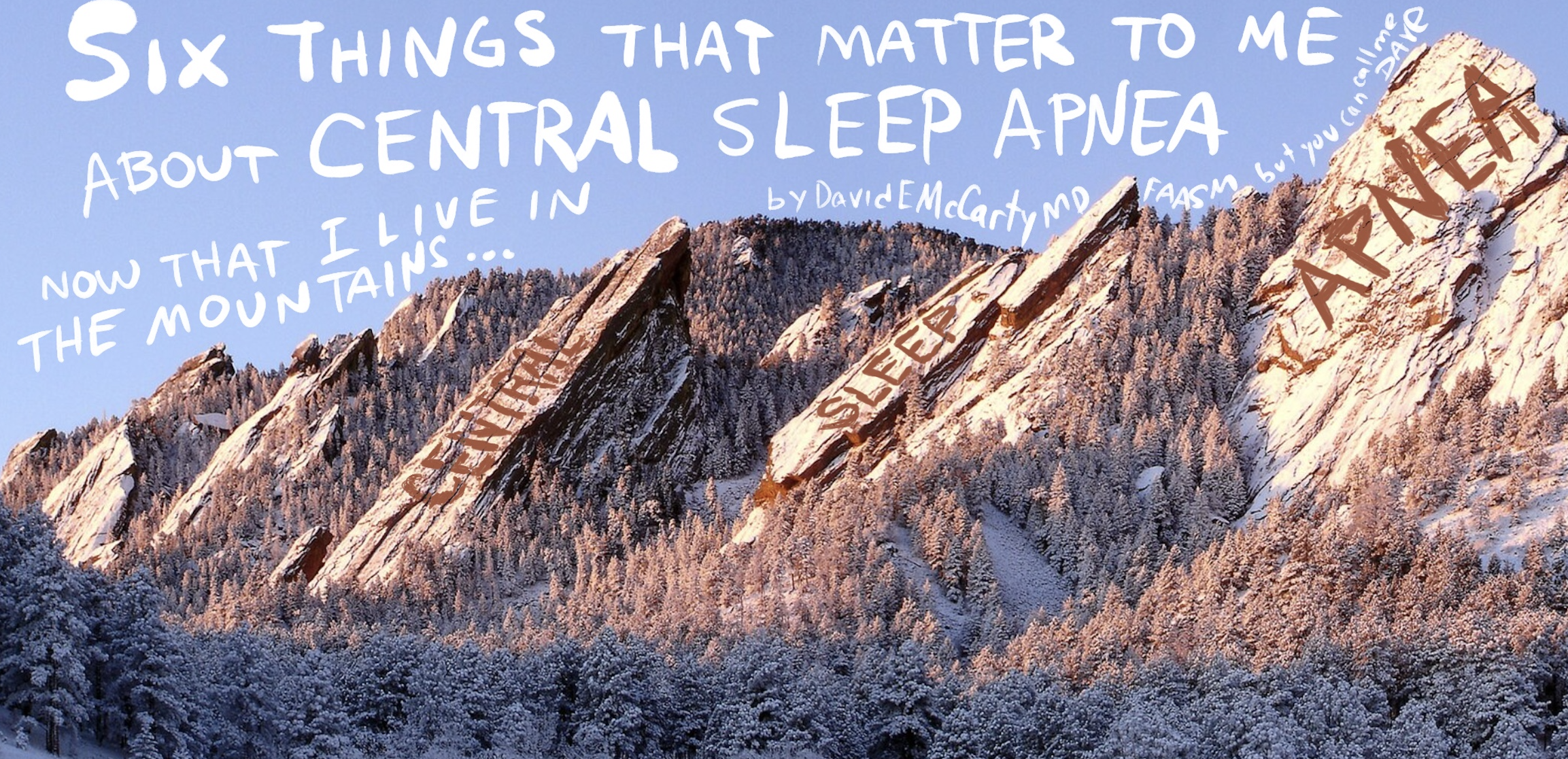
Life amongst the Flatirons…anything but FLAT!! :)
~ ~ ~ ~ ~
By David E. McCarty, MD FAASM (…but you can call me Dave)
3 February 2026
~ ~ ~ ~ ~
“Not everything that is faced can be changed; but nothing can be changed until it is faced.”
— James Baldwin [1]
“Once I get you up there, where the air is rarefied
We'll just glide, starry-eyed…”
— “Come Fly With Me,” Sammy Cahn & Jimmy Van Heusen, performed by Frank Sinatra
~ ~ ~ ~ ~
A Note from Higher Ground
I keep coming back to Baldwin’s line when I think about central sleep apnea (CSA) at altitude, because the mountains have forced me to face aspects of breathing physiology that were easy to miss at sea level.
Up here in thinner air, things that once felt abstract become personal: small physiologic nudges become big oscillations, devices behave differently. Diagnostic labels stop behaving altogether. Patterns you could once ignore start waving their arms and asking—politely at first, insistently later—to be noticed.
This essay is not a guideline. It’s not a rebuttal. It’s not an argument for or against any particular machine, medication, or metric. It’s a set of lessons learned after moving into thinner air—observations that only became unavoidable once oxygen tension dropped and humility rose to meet it.
Consider this a signal fire from the mountaintop. Not commandments. Not tablets. Just navigational markers meant to help us look at the same sky.
If we’re going to manage Central Sleep Apnea (CSA) well—especially in the Mountain West—we need shared orientation. We need to agree on what we’re actually looking at, what the moving parts might be, and why we’re even intervening in the first place.
With that spirit in mind, here are six things that matter to me about CSA in the mountains—starting, of course, with the obvious fact that altitude itself matters.
So hop aboard the Blue Balloon, and we’ll fly up…up…up…where the air is rarified…
~ ~ ~ ~ ~
1. Altitude is an ACCELERANT for CSA Physiology…and it’s on a GRADIENT
Let’s start by naming the ground we’re standing on.
At altitude, central oscillations of respiratory effort become progressively more common and more difficult to treat with standard PAP therapy. This is not controversial. It’s not speculative. It’s been demonstrated repeatedly in populations living throughout the Mountain West.
What about treatment emergent central sleep apnea (TECSA)? In one oft-cited study examining PAP-treated patients at different elevations, the percentage of individuals developing a central apnea index greater than 5 events per hour increased from 10.6% at 1,421 meters (4,660 feet) to 38.7% at 2,165 meters (7,100 feet).[2] That’s not a rounding error. That’s a different physiologic environment, and it demonstrates a dose-effect. Altitude is an accelerant for central apnea physiology, more likely the higher you go. Around here, we’ve learned that TECSA—to some degree—becomes nearly universal at 10,000 feet and higher.
What’s happening here is not pathology so much as ventilatory instability. At altitude, lower ambient oxygen tension promotes hyperventilation. Hyperventilation lowers PaCO₂. When CO₂ approaches or dips below the apneic threshold during sleep, breathing becomes unstable. Periodic breathing and central events emerge—not because something is “broken,” but because the system is exquisitely sensitive.
Here’s the important reframing: Common does not mean irrelevant—but it does mean contextual.
In many patients living at altitude, central events are an expected physiologic response. The question is not “Are centrals present?” but rather “Do they matter?”
This distinction matters. A lot.
One elegant demonstration of this comes from the same altitude literature: an alternative protocol using supplemental oxygen prior to CPAP or bilevel PAP titration achieved optimal or good titration results in 95% of patients with treatment-emergent central apnea.[2] Oxygen doesn’t “treat a disease” here—it simulates taking altitude out of the equation, stabilizing the control system. It simulates sleeping in Los Angeles, at sea level.
Which brings us to a recurring theme of this essay: CSA at altitude is not an enemy to be eradicated. It is a signal, and sometimes a transient one, and it has many moving parts. Some individuals acclimate over time. Some never do. Either way, the presence of central events alone does not automatically create an ethical obligation to intervene.
Up here, normal looks different. That doesn’t mean we ignore it. It means we interpret it carefully.
~ ~ ~ ~ ~
2. Periodic Limb Movements Matter More Than We Think (Especially Up Here)
Now we step into territory where the literature goes quiet—but the physiology does not.
The study of sleep at altitude has focused almost exclusively on respiratory parameters: central apnea indices, oxygen saturation, periodic breathing patterns, cerebral blood flow, and ventilatory control mechanisms. Meanwhile, the study of periodic limb movements of sleep (PLMS) has evolved along a completely separate track, examining their prevalence, scoring definitions, and clinical significance in populations largely studied at or near sea level [3].
These two literatures barely acknowledge each other.
To my knowledge—and I say this plainly—there are no published studies examining whether altitude increases the likelihood that limb-movement–associated arousals provoke centrally mediated respiratory instability. That absence is real. It’s not an oversight on my part.
And yet.
Clinically, it’s hard to ignore what we see.
At altitude, the ventilatory control system operates with high loop gain and a narrow CO₂ reserve. In that environment, any arousal—respiratory or non-respiratory—has the potential to trigger ventilatory overshoot. Overshoot leads to hypocapnia. Hypocapnia invites central hypopneas or apneas.
PLMS are, by definition, arousal-generating events. Each movement is a small sympathetic jolt. At sea level, this may be inconsequential. At altitude, it may be the match that lights the fuse.
This is not a claim of established causation. It is a mechanistically plausible hypothesis grounded in observation. The mechanism—arousal-triggered hyperventilation in a hypocapnic milieu—is well described. What’s missing is the study that measures limb movements and respiratory instability together at altitude.
Until such data exist, the ethical posture here is humility. When CSA appears unstable at altitude, and PLMS are present, it is worth asking whether we’re treating the right part of the narrative.
Sometimes the breathing isn’t broken. Sometimes the sleep is.
~ ~ ~ ~ ~
3. Mouth Breathing Changes the Story
Mask choice is often discussed as a matter of comfort or preference. At altitude, it becomes something more consequential.
Multiple studies have demonstrated that oronasal masks increase upper airway collapsibility and therapeutic pressure requirements compared with nasal masks [4]. In one careful physiologic analysis, oronasal masks increased pharyngeal critical closing pressure by approximately 2.4 cm H₂O and required 2.6 cm H₂O higher therapeutic pressures than nasal masks [4].
That matters everywhere—but it matters more at altitude.
Higher pressures increase ventilation. Increased ventilation lowers PaCO₂. Lower PaCO₂ pushes the system closer to the apneic threshold. The result? Instability that looks, on paper, like “treatment-emergent CSA.”
Here’s the narrative trap:
The patient starts PAP. The AHI destabilizes. Central events appear. A label is applied. Escalation begins.
But sometimes the “CSA story” is being narrated by the mask.
At altitude, mouth breathing is not a benign variable. It changes airway mechanics, pressure needs, ventilatory drive, and ultimately stability. Nasal breathing—supported assertively when needed—is not a lifestyle preference in this context. It is a physiologic strategy.
Change the narrator, and sometimes the plot resolves.
~ ~ ~ ~ ~
4. Over-Pressurization and EPR Can Create the Problem We’re Trying to Fix
This is the lesson that took me the longest to fully accept, because it challenges a deeply rehearsed reflex in sleep medicine: If events persist, increase support.
At altitude, that reflex can backfire.
Recent work has demonstrated that treatment-emergent central sleep apnea may resolve when inspiratory pressures are lowered, not raised [5]. This finding is not intuitive if one is thinking exclusively in obstructive terms—but it makes perfect sense when viewed through the lens of ventilatory control.
Similarly, pressure support features such as expiratory pressure relief (EPR) or bilevel pressure differentials can exacerbate hypocapnia in susceptible individuals. This phenomenon has been recognized for decades in case reports and physiologic studies [6] but it tends to be forgotten in modern algorithm-driven practice.
At sea level, these effects may be modest. At altitude, they can be decisive.
This is where iatrogenesis quietly enters the room. We are not “doing something wrong” out of negligence or malice. We are doing what we have been trained to do—responding to numbers. The problem is that at altitude, the system is already on edge. Our tools speak louder up here.
Sometimes the most stabilizing intervention is not escalation, but restraint.
Or, as I occasionally say to myself in clinic: Just because you can turn the knob doesn’t mean you should.
~ ~ ~ ~ ~
5. Circulation Time Still Matters—Even When the Literature Is Silent
The role of prolonged circulation time in CSA—particularly in heart failure—is well established [7]. Delayed feedback between gas exchange in the lungs and chemoreceptor sensing in the brain contributes to the waxing–waning pattern characteristic of Cheyne–Stokes respiration.
What is less well studied is how changes in circulation time outside of overt systolic heart failure, such as those associated with atrial fibrillation, interact with CSA physiology—especially at altitude.
Here again, the altitude literature and the cardiovascular CSA literature largely pass each other in the night. Studies of CSA at altitude focus on hypocapnia and cerebrovascular reactivity [8-9]. Cardiovascular reviews acknowledge associations between atrial fibrillation and CSA but do not examine how newly developed AF might destabilize previously stable PAP therapy.
And yet, clinically, we see the pattern: A patient’s therapy is stable for years. Atrial fibrillation develops. Suddenly, breathing becomes unstable. Central events proliferate. The same device, same settings, different physiology.
Is this mediated by changes in circulation time? Altered cardiac output? Neurohumoral shifts? We don’t know. What we do know is that the narrative has changed, and pretending otherwise helps no one.
At altitude, small delays matter. Feedback loops stretch. Oscillations grow.
When the cardiovascular chapter of a patient’s story changes, the CSA chapter may change with it, and a goal of re-establishing cardiovascular balance may be appropriate.
~ ~ ~ ~ ~
6. Amygdala “Twitchiness” and the State of the Nervous System
Closely related to the arousal index—but worth naming on its own—is the baseline state of the nervous system, particularly the reactivity of the amygdala.
Imagine two identical twins separated at birth: one becomes a Zen monk, the other is traumatized in war. Same airway. Same chemoreceptors. Same altitude. And yet, anyone who has spent time in clinic knows the second brother is far more likely to experience distressing recovery breaths, upper airway resistance discomfort, and exaggerated ventilatory responses to minor perturbations. This is not a claim of destiny or weakness; it is a recognition that sympathetic hyperarousal changes how the sleeping brain interprets bodily signals.
In a state of chronic threat vigilance, the transition from sleep to arousal is sharper, the ventilatory response more abrupt, and the likelihood of overshoot greater—particularly in the hypocapnic, high–loop-gain environment of altitude, and particularly if the patient is breathing with the open-mouthed posture. Considered this way, psychological “twitchiness” becomes one of the tweakable moving parts in the CSA ecosystem. It opens the door—ethically and clinically—to cognitive, behavioral, and psychological interventions not as adjuncts or afterthoughts, but as legitimate tools for stabilizing breathing by calming the system that interprets it.
~ ~ ~ ~ ~
A Word About Treatment (and Why We Sometimes Don’t Need It)
One of the quiet truths revealed by altitude is this: CSA stabilization is rarely about mortality risk.
Outside of specific contexts—advanced heart failure, significant opioid-induced hypoventilation—the evidence does not support a clear survival benefit from suppressing central events. Trials have demonstrated event suppression, improved indices, even improvements in left ventricular ejection fraction, but not consistent mortality reduction. In some cases, harm has been suggested.
Which means that most CSA treatment decisions—especially at altitude—are about sleep continuity, daytime function, partner relief, and comorbidity management, not longevity.
Folks, this matters because it reframes the ethical question—the diagnosis alone is not a mandate to treat. Presence alone is not a verdict.
At altitude, many individuals exhibit CSA that is physiologically understandable, clinically mild, and functionally irrelevant. In such cases, the most empowered intervention may be education, reassurance, and watchful patience.
Or, as I sometimes tell patients: Not every knot needs to be untied. Some just need to be understood.
~ ~ ~ ~ ~
Lessons from the Mountaintop
From higher ground, CSA isn’t a well-defined adversary, it’s more of a puzzle, with many moving parts.
CSA speaks louder in thin air, getting worse the higher you go, with altitude being an accelerant for the other moving parts, like circulation time, other sources of arousal, and iatrogenic over-ventilation.
The six things I’ve described here haven’t given me better answers. They’ve given me better orientation—a shared language to explore complex narratives with patients who live in the same physiologic landscape I do.
Up here, that turns out to matter more than I expected.
And that’s a problem that I’m ready to face.
Kind mojo & steady footing,
Dave
David E. McCarty, MD, FAASM
Longmont Colorado
3 February 2026
~ ~ ~ ~ ~
References
Baldwin, James A. “As Much Truth As One Can Bear.” The New York Times Book Review, January 14, 1962.
Burgess KR, Ainslie PN. Central sleep apnea at high altitude. Adv Exp Med Biol. 2016.